

Our Vision
This website proposes to explore a dimension of spirituality that centers on the Supreme Person. More controversal is our approach of the Divine Couple. Granted, the Absolute is beyond personality and gender. Yet aren't we all persons, made in some divine image? The word GODHEAD resolves this confusion in that it contains both male and female principles and includes aspects of Divinity both personal and impersonal.
GODHEAD proposes to stand at once for "He", for "She, and for "It". GODHEAD becomes "THEY", akin to the Christian Trinity. And as Christians worship One-in-Three, Indians worship One-in-Two. As the Source of all created males and females, isn't it a surprise that in the West GODHEAD the reality of the Divine Couple has hardly transpired? GODHEAD is Yin-Yang, the Taoïst circle of perfection inside which a swirling danse of two complementary opposites takes place.
A relationship with GODHEAD is not permanent fusion. It's an on-going play, a danse. Unlike the proverbial drop of water merging in the ocean, we countless souls possess a minute individual identity within the Whole. We ARE Gods, yes! In quality, that is ; a spark of light blissfully existing as part and parcel of the Supreme Person. Nothing new here.
If the essence of love rests on free-will, life on earth would be a space where self-centered pursuits are possible. The cost of such freedom is often called karma. Think of karma as the result of the good and bad decisions we make. It binds you to matter repeatedly. While being, at best, humble servants of the Center, any attempt at taking center-stage carries its toll of consequences. This is called responsibility, its ramifications being nothing less than the painful network of learning curves associated with spiritual growth. And when at last we turn to selfless service to one anotherin connection to our common Source, an endless relationship of blissful play can begin. As described in Indian scriptures and other sacred texts, "Lila" is the sanskrit word for an eternal interplay. Are we ready?
Universal Spirituality
Non-sectarian religion is hard to find. Typically each group views its revelation as the most directly handed down to maindkind. Some consider their messiah or tradition as the one and only way to God. This may feel safe for them, just as it is safe to accept one's medical authority when they tell you, "Don't listen to anyone but me (or you'll get confused.) The same principle applies to groups who view themselves as "the best" among good religions. And who would argue with a child who believes his parents are better than yours? Is it not natural for a child? As they grow up, children just as naturally come to view their parents in a more relative perspective in context to other parents. Does this minimise their exclusive love and affection to their own? Probably not.
In the Bhagavad-gita, India's most translated Vedic text, the Blessed Lord is said to declare:
I reside in everyone’s heart. Should anyone desire to worship a particular God, I make his faith strong and steady."
This suggests a God who respects anyone's free choice of spiritual practice, good or bad, including a life of disbelief, without judgement. Would this apply to all areas of life by any chance? It may indeed. Whatever man or woman you marry, whatever political party you adhere to, Life gives you somehow the conviction (at least for some time ) that you're making the right choice.
Such is this website's vision of faith. Should it resonate with yours, feel free to explore these pages to your full satisfaction. Should you disagree, chances are that your visit will still be useful to you.

PRACTICE

Prayer & Meditation
1. Meditation
Among spiritual practices, prayer and mediation are probably the most universally recommended. Whether with mantras, holy names, or words of surrender, chanted in community or in solitude, in song or in complete silence, heartfelt communion with one’s preferred Godhead is a sure way to elevate your soul.

Community vs Solitude
Some say, "No one will stand between me and my Lord".
If there is one area where we're advised to beware of others' good intentions, it is religion. On the other hand walking the spiritual path alone can be riddled with danger. As few people manage to get a degree without going to University. 90%+ of us require courses, curiculum, and community to get us through.

Philosophy
Einstein famously said, “Science without religion is lame, religion without science is blind.” (“Science and religion,” 1954).
Hence you will find in this website a number of articles and essays with philosophical insight.
We often hear that feelings matter more than understanding. How much of the Divine can you grasp? We're told, "Don't let your intellect interfere with your feelings". Likewise, mental influences are blamed for being "in the way" of true intuition.
According to Einstein, however, emotion and rational thinking best work as a pair. Here is how he puts it:
"The most beautiful emotion we can experience is the mystical. It is the power of all true art and science. He to whom this emotion is a stranger, who can no longer wonder and stand rapt in awe, is as good as dead. To know that what is impenetrable to us really exists, manifesting itself as the highest wisdom and the most radiant beauty, which our dull faculties can comprehend only in their most primitive forms—this knowledge, this feeling, is at the center of true religiousness. In this sense, and in this sense only, I belong to the rank of devoutly religious men."

Worship
Our Themes

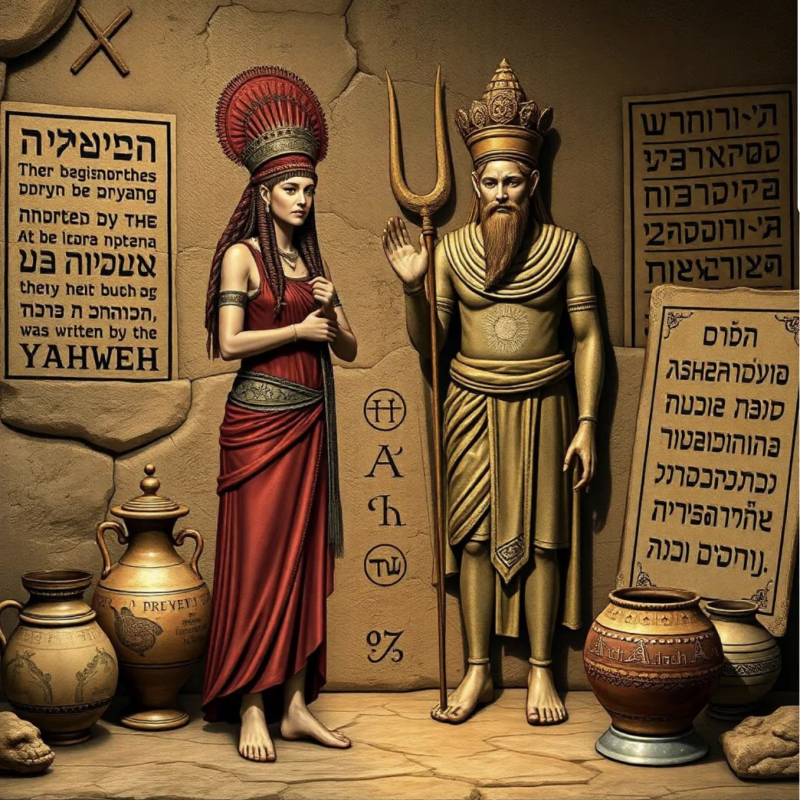
Asherah & Yahweh
Temple of Jerusalem between 930 and 587 BC

Hera & Zeus
Parliament of Austria in Vienna

Juno & Jupiter
by Gavin Hamilton

Magdalen & Christ
Renuniting after the resurrection

Radha & Krishna
As One in mystical Union
The Divine Couple accross cultures
The reality of a Divine Couple remains unsettling in the West.
On the one hand, if the Absolute is One and unique, how can it be two? On the other hand, Universal Consciousness, as the supreme energy beyond gender, offers the advantage that the so-called stronger sex is no longer at risk of dominating the so-called weaker sex, nor of reigning as a solitary God the Father.
But how then can we not lose sight of the notion of a personal Divine being who is "someone," rather than an impersonal energy?
Few of our contemporaries know that Yahweh, the one God of the Old Testament, was not always "alone." At his side in the Temple of Solomon (in Jerusalem between 930 and 587 BC), stood Asherah, his beloved Goddess. Biblical passages mention that Asherah was also known as Elat, the feminine equivalent of Yahweh, the God of Israel (2 Kings 23:6). Archaeological research has corroborated that she stood near Him in Solomon’s Temple.
Any student of comparative religions will undoubtedly notice an unavoidable connection to the Divine Couple venerated in Hinduism. Lakshmi-Vishnu, Parvati-Shiva, and the earthly incarnation of Radha-Krishna are the best-known variations of the Divine Couple. In the modern era, across India, Radha-Krishna has become more popular than ever.
In Taoist China, the Yin-Yang couple represents the essence of the absolute circle, with the masculine-feminine polarities highlighted within the circle as two droplets swirling towards one another. In his book, *Allah au féminin* (Albin Michel, 2020), Eric Geoffroy, a French Islamic scholar and writer, speaks of an essential reality of Islam, always hidden yet inherent in the teachings of the Prophet Muhammad. “The Feminine is the divine light, which is not a creature but a creator.” In Egypt, Isis is the quintessential Goddess. She embodies the universal nurturing mother in whom all women are united. With her husband Osiris, their story was the first tragic love story in Egypt.
For Christians today of the Divine Couple of Solomon? Since Asherah and Yahweh are no longer venerated in any of the patriarchal churches for centuries, one can easily observe a masculine over-representation of the Divine. Could this be the result of a perpetual masculine desire to assert its dominance over the feminine? This tendency would not be new in history. More surprising is the passivity of modern Christian believers, who seem largely unconcerned by the absence of a Companion alongside the Heavenly Father. Certainly, the advent of Christ changed the game regarding the solitary God. It would be useful here to mention the concept of "Lila," the Divine Play, central to Hinduism and implicit in other religions. Divine play would resolve a number of enigmas.
Benefiting from a vast entourage of archangels at his service, our Christian God sends the Angel Gabriel, with his message of annunciation to Mary, a mere mortal. To bless her above all women, God conceived her immaculate and exalted her as the Mother of God’s only Son. It was through her and the Holy Spirit, that Jesus was conceived and, according to the Holy Trinity, was called God the Son. “A woman can hardly do better than to be raised to the status of Mother of God,” noted Charles-Raphael Payeur, Bishop of the Catholic Church of Quebec, during a recent seminar on the Marian conception in Lourdes.Yet Mary has never been considered on an equal footing with God, as a Goddess would be. Certainly, a divine desire to elevate a woman "to the threshold of the Divine" is in itself unprecedented. Unheard of! The Roman Catholic Church has also distinguished itself from other Christian institutions by blessing a Virgin Mary among all women. It is pointless to consult Protestant churches, which have always remained opposed to their faithful praying to the Virgin Mary, since prayers are to be addressed only to the Father and the Son. As for the nature of the love that unites the heavenly Father and the earthly mother of Jesus, no Christian church has ever addressed it. Some theologians have preferred to sidestep the question by suggesting that God is beyond all gender considerations ; questions of gender are considered to be solely human. According to these theologians, while the concept of "God the Father" may seem eminently masculine, it is in fact merely a figure of speech intended to make the concept accessible to us. Just like the phrase "God made man in his own image," which many have chosen to interpret as a metaphor. In this case, there is no need to answer questions like "In whose image would woman be made?" In a more literal sense, however, "God the Father" poses a problem. Where can we find a Mother Goddess who, before being Mother, is Eternal Companion?This may seem complicated, but is it really? Not if we insist that the God of Love is the first among all beings to experience a loving union with his feminine counterpart. Should they not share the conjugal love of which they are the origin?This is unacceptable to the defenders of the Divine Couple, in whose image the human couple is made. For them, it is time that "In His image" became "in THEIR image," because what man is in the image of God, woman is... in the image of the Goddess. Of course! Faced with the absence of sacred texts recounting the love of Yahweh and Asherah, just as there is no mention of the Taoist Yin-Yang in its symbolic dance, let us turn for a moment to the Hindu Divine Couple. In the Vedic conception, God and Goddess love each other tenderly, even passionately. For if we humans are endowed with such a sweet privilege, how could our Source not be? “On earth as in heaven!” Is this logic dangerous, like the carefree intrusion of a child into their parents’ bedroom during an intimate moment, with the risk of interpreting their lovemaking as a fight? Or is it the legitimate and reassuring instinct of the innocent child to desire to feel the reciprocal love that unites their parents? In the Vaishnava tradition in India, the intimacy of Radha and Krishna is described in poetry. These texts are coded and remain reserved for initiated sages. The custom is for the faithful to rejoice at the idea that God and his Goddess love each other “madly.” It must be possible for every man and woman throughout the world to feel the spiritual connection between their experience of physical love and their experience of their Divine Source.
For one who sees Me everywhere, and everything in Me

It is one thing to imagine Divinity somewhere above our heads. In the Bhagavad-gita (often called India's Bible), Lord Krishna tells his friend and disciple Arjuna, "For one who sees Me everywhere and sees everthing in Me, I am never lost, nor is he ever lost to Me." The animist conception is similar: seing God's presence in every tree, in every being. A stone isn't God in itself ; a sacred cow isn't worshipped for her own sake. If spirit is in all beings and things the Divine exists everywhere. Didn't Christ mean just that when he said, "whatever you do to the least of creatures, you do it unto me."? Selfless service to others can be offered out of human kindless by anyone, but the intention of pleasing Divinity through that service carries a direct loving connection with Divinity. Magic happens when you become, so to speak, the hand of God. As your hand is by its nature your unconditional servant, it is anyone's capacity to becomes God's menial servant. A king's servant isn't the king, yet he may eat the king's remnants and reside in a palace. Just see! In Lord Krishna's words above, the Lord is never lost to such a devotee, nor is the latter ever lost to his Lord. Let's imagine this world as a kingdom and we as its servants....
PERSPECTIVES
Life-changing Events
Nowadays a form of spiritual practice has emerged in spiritual circles which consists in raising one's consciousness to what has been identified as higher vibrational frequencies. While study definitely participate in raising one's consciousness, study alone will not be enough.
As new perspectives appear when one rises in the air, taking the high ground in consciousness is a sure way to perceive reality from a viewpoint that remains inaccessible in day-to-day life.
For the last few decades coaching is offered, for free or for a fee, to help you elevate your energy levels.
Besides, a "new" phenomenon is taking place around the world with a growing number of testimonies from victims of serious accidents. In 1975 a seminal research was published by psychiatrist Raymond Moody based on the testimonies of 150 people who had undergone near-death experiences (NDE). Such ground-breaking investigations have grown since thanks to the spectacular rise in ressucitations taking place on operation tables. Compelling reports from "experiencers" have lead surgeons and scientists alike to take NDE very seriously. Besides NDE, out-of-body experiences (OBE) often trigger radical shifts from ordinary awareness. Typically, various psychic gifts such as precognition and healing.capabilities manifest in experiencers for the rest of their lives. People who'd lived self-centered lives turn to caring for others as a newfound vocation and purpose.
Such developments cannot be underestimated in that they highlight the importance of true awakening as opposed to simple faith or knowledge in scripture and oratory skills. Its's about incarnating spirituality in your consciousness above all personal qualities.
Personal vs Impersonal
This is a huge topic.
Is GODHEAD a Personal Being, or is "It" an Imperonal Absolute. Could it be both, and can you choose? Such has been the dillema accross cultures for millenia.
The notion of a formless Source has become increasingly prevalent in modern days. At first glance it doesn't seem logical that the origin of a sound be silent, of kindness be unkind, or of beauty be formless. This may explain why human beings would have conceived a God in their physical image. Difficult to look at the human body and not notice the anatomic perfection in it. Should the Divine have an eternal body, difficult to match the beauty and functionality of an ideally formed man or woman.
No wonder then that incarnations of the Divine Couple accross cultures, whether it is Asherah-Yahweh, Hera-Zeus, Juno Jupiter, Sita-Rama or Radha-Krishna, invariably appear as prime specimens of Beauty.
It is hardly surprising that advocates of impersonalism dismiss with a sweep of their hand what they view as the human weakness to bring down the Divine to our anthropomorphic level. By definition the formless Absolute cannot be seen ; much less be confined in a body. The human form itself is a temporary vessel from which our formless spirit is meant to free itself after death. In India the Adwaita Vedanta school, one of the foremost religious traditions in the subcontinent, is a strong advocate of the impersonal view. Its followers consider even Divine Incarnations like Rama, Krishna, or Jesus Christ, as mere personifications of the formless Brahman (the all pervading Absolute). Likewise, the major currents of Buddhism never mention a Supreme Person. Instead, they posit Śūnyatā (emptiness, voidness) and Anatta (non-Self, no soul) as Supreme.
While this website has stated at the outset that GODHEAD includes both personal and impersonal aspects of Divinity, your personal leaning toward one or the other is entirely yours.
The Divine Play
fdfdfdfd


Mental Agitation
Quotes
Einstein once said: "Chance is determined by forces we do not control; for the insect as for the star, human beings, vegetables or stardust, we all dance to the rhythm of a mysterious tune played in the distance by an invisible flute player."

I'm a Non-believer
There's one great advantage in being a "non-believer". It is widely underrated. You can always suspect a theist for being motivated by the perspective of Heaven after he dies for being a good fellow. The fear of hell can be even more compelling in keeping one from acting badly. Fear and greed being about the most powerful drives in the world, you'll never know whether love and compassion had anything to do with acting kindly to your fellow human being.
After all is the atheist less capable of love and compassion, of charity and altruistic behaviour, than any pious person? Doesn't he have the definite advantage of not being motivated in life by hopes of reward or punishment after death?
In 1232 Pope Gregory IX established the Inquisition for the suppression of heresy in northern Italy and southern France, becoming notorious for the use of torture. Among condemnable deeds foced conversion by the faithful has been responsible for earning God a bad name.

Guilt - Friend or Foe?
Mea Culpa, Mea Culpa, Mea Maxima Culpa. C'est ma faute, c'est ma faute, c'est ma très grande faute.
Are Relationships A Preperation?
Love comes and goes. Or does it? Ostensibly, in this world at least, we meet people, partners, friends and foes...only to part at at some point. What if we met again after we die to look at unresolved issues we may have left behind us? Making up with enemies who could as well have been friends in different circumstances.
If some of us have fallen out with Godhead, is this the end of it?
Stories of atheists turning people of faith abound. Others remain adamant disbelievers till the bitter end. Death is for them the end of them. The body goes back to the earth it came from, as ashes or in a coffin. Survivers of near-death encounters tell a different story, but what if they didn't really die? Case dismissed.
The different story is told by a number of NDE experiencers who, gazing at their bruised body from the ceiling of an operation room after some deadly accident, have reported feeling more alive than they'd ever been. Never mind that their heart's electrical activity showed a flat line on the electrocardiogram for several minutes. According to esoteric authorities (who write books on the afterlife), patients failing to be resuscitated after surgery remain in denial of their passing long after their bodies were burried. Other late persons wake up to the reality of their death only upon meeting a long-gone relative who'd come to greet them at the threshold of the hareafter. Others realise their postion upon being told by the late relative, or by what they perceived as a Being of Light that, "You're time hasn't come yet, you must return to your physical body."
In some reports experiencers are given the choice to return. Despite their strong attraction to soar up to the light before their spirit, they may choose to continue their incarnation for the sake of a needy spouse, or dependant children,
Who's behind this website?
Call me Felix (my third legal first name). I'm a life-long filmmaker of spiritual documentaires. Other than that, I claim no official authority or credentials other than having spent a long life of study and practice in spiritual awakening. The contents of these pages are my humble insights, for what they're worth. On the other hand you can rely on the solid support I refer to from various recognised sources in the fields of religion and philosophy. As a budding filmmaker in 1989, the American Video conference (AVC) awarded my first professional production, Timeless Village Of The Himalayas, with a first prize, under the auspices of the American Film Institute (AFI). Since then some fifty documentaries have followed, now available you everyone on my Youtube channel: BhakTV,
My urge to share thoughts had been nagging for years. Kindly overlook my use of the English language, which is second to my native French. I look forward to your active feedback in the blog section. My purpose being none but to inspire Internet seekers of the ultimate subtleties of life, I pray to count you as one of them.
Let Us Know Your Feedback
Localisation
La Creche
France