Personal vs Impersonal
This is a huge topic.
Is GODHEAD a Personal Being, or is "It" an Imperonal Absolute. Could it be both, and can you pick your preferred inclination? Such has been the dillema accross cultures for millenia.
The notion of a formless Source has gained importance in modern days. At first glance it doesn't seem logical that the origin of beauty be formless, just as the origin of sound or kindness isn't silent nor unkind. Hence, rather than creating a God in their physical image, human beings would logically be the one's modeled after God. Moreover, it's hard not to notice the anatomic perfection of the human body. Hence, if the Divine has an eternal body, nothing is easier than to imagine it as an ideally formed man and woman (God-dess). No wonder then that incarnations of the Divine Couple across cultures ---Asherah-Yahweh, Hera-Zeus, Juno-Jupiter, Sita-Rama or Radha-Krishna--- are invariably archetypes of human beauty. Such personal manifestations can serve to show that God's physical appearence is not fixed like ours ---it is multifarious and varigated, according to diverse cultural lenses. As beauty is in the eye of the beholder, your Deity's face may take on a different hue or feature for each one of us depending on your taste and religious persuasion. To use an example, beside the standard description of Krsna given in the Hindu scriptures, my Krishna may look different than yours.
No doubt, animal forms are also perfect. In fact the Vedic texts list ten sample avatars of Vishnu. The fish incranation was first (so are aquatics in the Darwinian evolution of species). Then came the amphibian turtoise, the wild mammal, the half-animal-half-human, the human dwarf, the fierce warrior, the noble king, the romantic youth, and the wise sage. The eighth and last incarnation will be riding on a white horse as the slayer of mankind, the only incarnation yet to come. An uncanny correpsondance between this ageless list and the modern vision of evolving species seems unmis Even the slayer of mainkind seems unmistakable. And now that humanity has become able to incarnate its own destruction, what better symbole for it than the slayer of manking?
A formess Being
The plot thickens when many believers insist that God doesn't need to have a form at all to define His personhood. Many Christians believe that the Holy Father does NOT have a humanlike form; yet they do profess that Jesus Christ IS God's form, which can bee seen as a fair option.
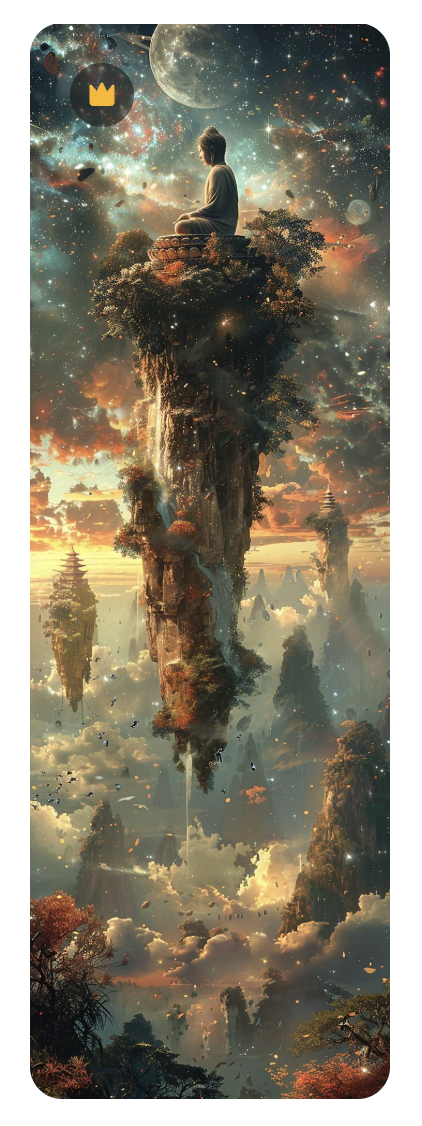
At the far end of the spectrum is the impersonal view, which stands to dismiss with a sweep of the hand the temptation of bringing down the Divine to an anthropomorphic level. Impersonalists view this tendency as a human weakness ---forgivable perhaps, but a weakness nonetheless. For them, by definition, the formless Absolute cannot be seen ---much less be confined in a body. The human form would be a temporary vessel from which our formless spirit is meant to free itself after death. In India the Adwaita Vedanta school ---one of the three major schools of Hinduism--- is a strong advocate of the impersonal view. Its followers consider even divine incarnations like Rama, Krishna, or Jesus Christ, as mere personifications of the Absolute Brahman. Likewise, the major currents of Buddhism never even mention a Supreme Person. Instead, they posit Śūnyatā (emptiness, void, non-Self) as Supreme.
As stated at the opening of this website, GODHEAD stands for both the personal and the impersonal sides of Divinity. We consider that readers are entitled to follow their own intimate conviction on this thorny issue.