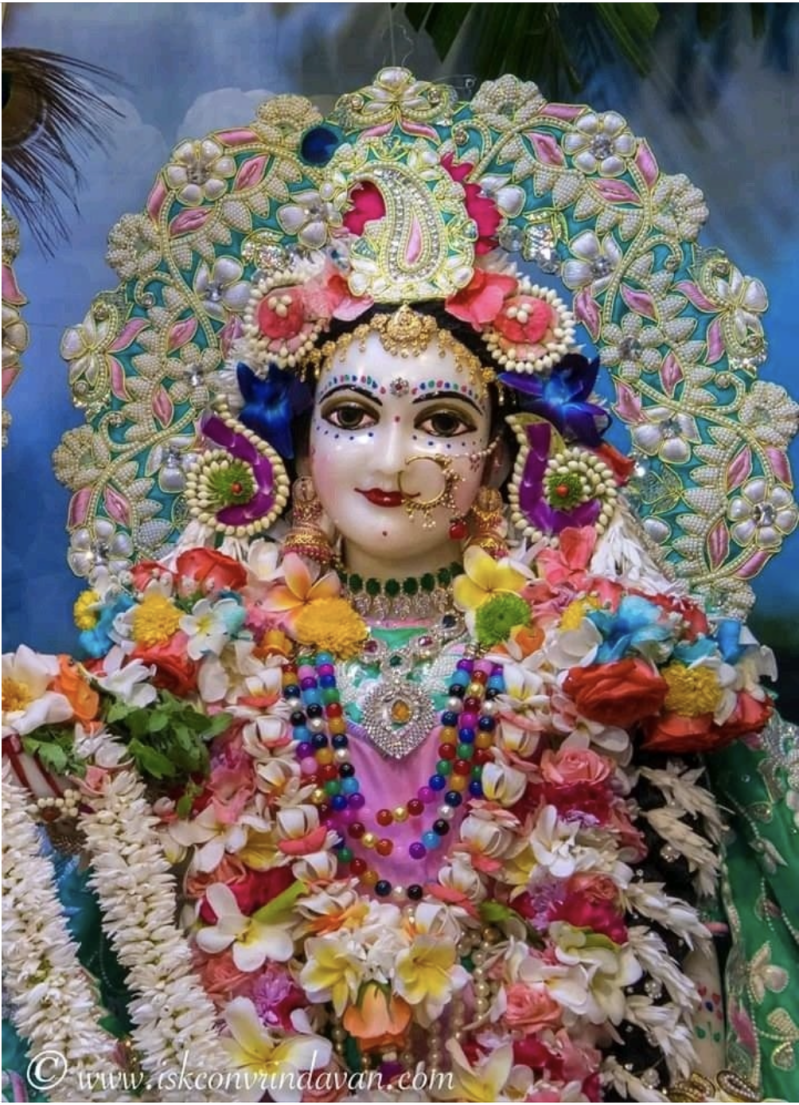
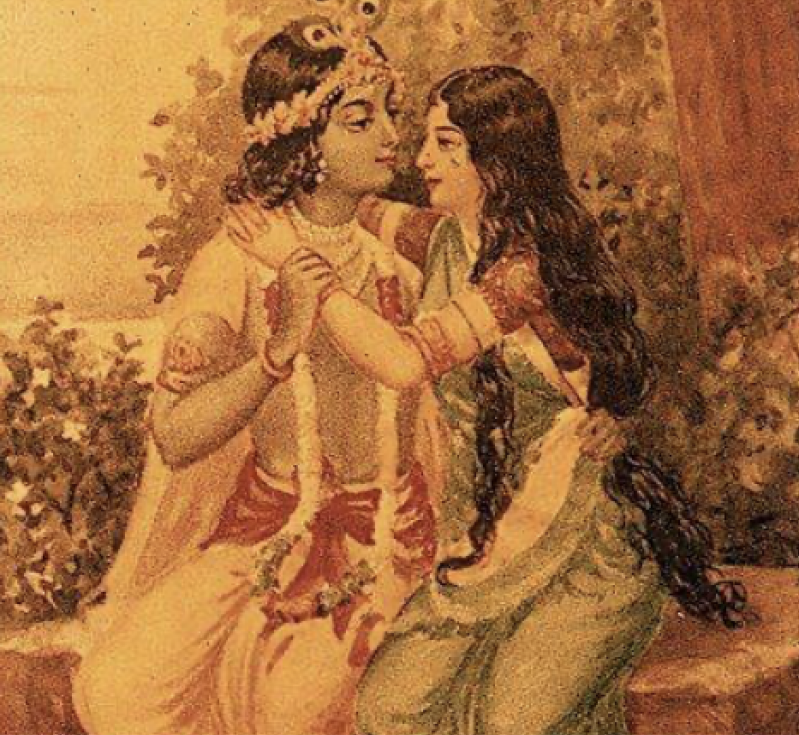
God's Face
In this article we're not asking, "Does God have a face?" This is another matter, and we shall leave it to preleminary studies.
What concerns us is the premise that the source of Beauty is the pinnacle of all beauty. It may be debatable for some but such is the paradigm, the theorectical model underlying our interest today.
And for once, let's start with a prayer, shall we?:
"Jagannatha Swami, nayana pata gami, bhava Tumi". O Lord of the universe, kindly become the object of my vision."
This ancient chant from Orissa was echoed in modern time by Beatle George Harrison in his immensely popular My Sweet Lord.
"I really want to see You Lord, but it takes so long. Halleluyah! Halleluyah! Hare Krishna! Hare Krishna!".
These two prayers, ancient and modern, are not about telling God what we want, before even deserving it. What about acting in such a way that "God turns His attention to me." Once that desire is there in the soul, the request to see becomes immediately more legitimate. That said there is an equally important Biblical promise,: Seek, and ye shall find. Obtaining the eyes to see the Divine is not another selfish desire, nor does it belong to any particular religion ----it is the essence of spirituality.
So what with God's Face? In Islam, "Allah has a face, you can't deny it", says Yasir Ibn Yousaf, a Western-based Islamic educator and speaker. Do we know what Allah looks like? "No", says Yasir,"because Allah hasn't revealed His face, nor has the prophet Mohammad. No one has seen Allah's face, we just know He has one."
Jewish scholar Maimonides argues that consciousness and the ability to speak are proof that God has a face. In Exodus 33.20, the Lord tells Moses, “But My face you cannot see, for no man sees Me and stays alive.” Jesus, however, added a crucial element: “Blessed are the pure of heart, for they shall see God.” (Beatitudes, Matthew 5:8). What an invaluable new information that is ---there will come a time when some deserving souls will be able to see God's face.
Now, if being pure of heart is the criterion for seeing God, Indian mystic poets like Jayadev, Vydyapati, Chandidas and Mirabai, had that grace as early as the 12th century. Jayadev's famed Gita Govinda, considered the jewel of Indian love poetry, first comes to mind. Here is an excerpt:
His golden garment and wreath of wild flowers stand out against dark limbs besmeared with sandalwood paste, jewelled earings dangling in play make his cheeks glitter, setting off the bewitching smile on His face. (Translation from sanskrit by C John Holcombe in his Jayadeva’s Gita Govinda)
Before Jayadeva no sanskrit scholar or poet had ventured to describe God’s face as it is nowhere to be found even in the four original Vedas. C John Holcombe puts forward the argument that,
“Buddhism and Hinduism sought to relase the enlightened from worldly illusion through renunciation, meditation and physical austerities. Particularly to be avoided was carnal pleasure. In Gita Govinda, however, Krishna embodies the erotic sentiment, and in that sens the cowherd girls serve Him with rapture and unselfishness. Jayadeva developed the aesthetic experience of love, and the poems typically end with dedications to Krishna, which urge readers to cultivate an appreciation of taste that is both mental discrimination and physical relish. The two are inseperable, each growing fom the other.The poems combine sweetness and poetry, and the joy that devotees find in relishing Krishna through the text. Indian theologians took this concept of taste even further, seeing the lover as someone lifted from the particular into an abstract and universal experience of love, which is the ultimate joy or beatitude, a taste of the Absolute itself. The aesthetic experience became a religious one, a state of total absorption in, devotion to, and enjoyment of Krishna.” (Jayadeva’s Gita Govinda, p.2-3)
But there is another face ---Radha's. She is Krishna’s counterpart without whom He would be another lonely Divinity, albeit surrounded by countless youthful cowherdesses. Radha is to Krishna what sunshine is to the sun disk. Think of the cowherdesses as rays of that sunshine. All three are one, inseparable, but Radha alone is equal to Krishna. Her face and personality are so dazzling, they attract even the most attractive One (in sanskrit Krishna means the “All-attractive”). Jayadeva writes in Gita Govinda:
...But still Krishna was equal with His kisses. Radha felt She should be first and left Him. And in those thickets humming bees encircle now unhappily to girlfriend said: ‘Now spilling sweetness from his flute and lips, and tremoulous the movement from His cheeks, in My heart I still see Krishna dance in palyful merriment and scorn of Me.’ (Jayadeva’s Gita Govinda, p.45)
As a child Krishna was notoriously mischievous. So is He now in the prime of youth, with the cowherd damsels of His earthly village. They’re all Radha’s followers and She doesn’t mind Him equally kissing all the girls. Her feeling scorned is only when He teasingly pretends to neglect Her as the very first and supreme Consort. Imagine the sun disk paying attention to each and every ray of its light. Now picture God caring for each and every soul in the universe. Well, that's what He does, if you can believe it.
I am the source of all spiritual and material worlds. Everything emanates from Me. The wise who perfectly know this are devoted to Me with all their hearts. BG 10.8.
The reason why the wise would choose devotion is explained in this verse. It's because Love is a two way street. What can souls do by knowing a sun-like God radiating Love on them all, if not radiating it back to Him? This is where the sun metaphore stops working ---unconscious sunrays don't radiate light back to their source. It would take consciousness and free-will for them to do that. And consciousness is exactly what souls possess. Hence, according to Krishna, that what the wise choose to do.
Referring back to the earlier muslim quote, ("No one has seen Allah's face, we just know He has one"), and Jesus' quote, "Blessed are the pure in heart, for they shall see God", we may add this one as a conclusion:
With their minds fixed on Me and their lives surrendered to Me, My devotees remain ever content in Me. They derive great satisfaction and bliss in enlightening one another and conversing about Me. BG.10.9