Before we get a glimpse of the Divine Play it may be useful to first take a look at the human play.
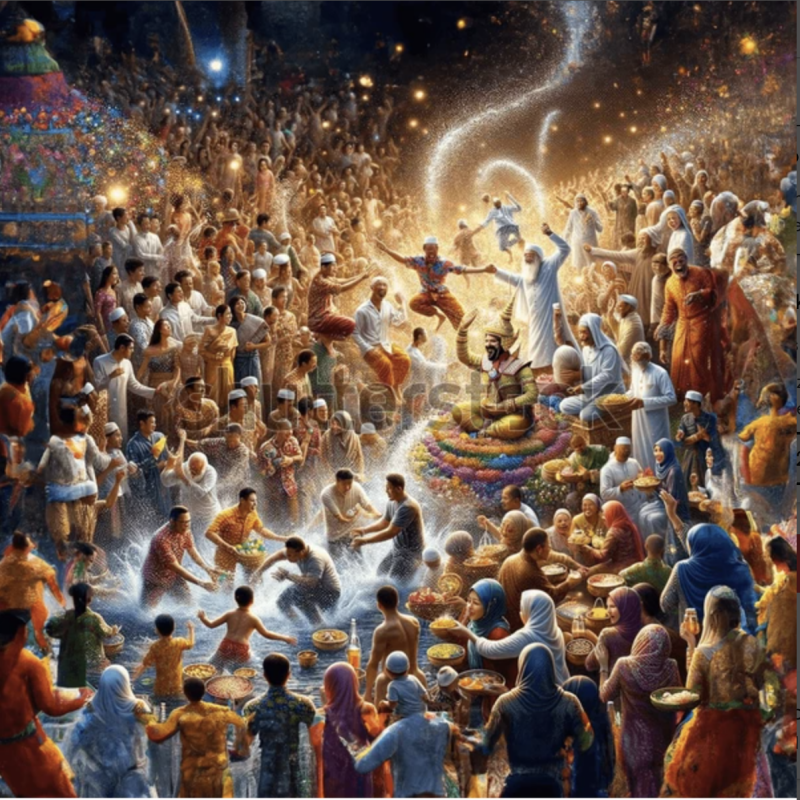
Most of us, whether we like it or not, we must work. With passion or by shere necessity, we must work to make a living. Some have an objective, a result-oriented purpose, or a drive to rise on the socio-professional scale. Others are dedicated to a cause they defend. Once in a while we take a break, which we call rest, recreation, leasure, or a holiday. No purpose there, only recuperating and having some fun; let's call it our human play.
In India the sanskrit word “Leela’ (लीला līlā,ˈliːlə) translates as "Divine play". One school holds that Creation, instead of being God’s objective for achieving a purpose, would be the expression of His playful nature. Another school holds that the act of Creation belongs more to the category of work, with a double purpose. One is to provide souls with a space ----separate from the spiritual world--- where they can exercise their free-will within a linear time structure. The other purpose would be for Divinity to manifest Themselves through occasional incarnations meant to help the evolving souls achieve liberation from matter. This act of compassion, although it can be viewed as being part of the Leela, is distinguised from blissful play in the Spiritual World.
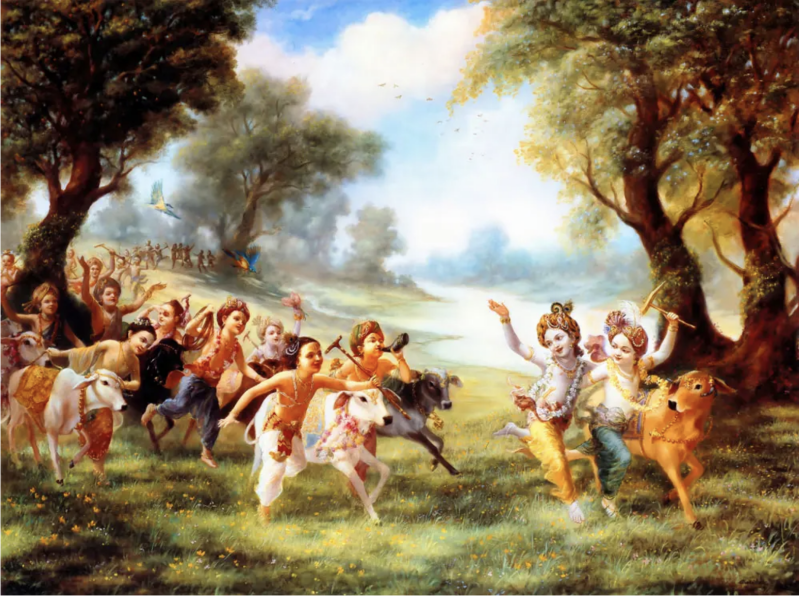
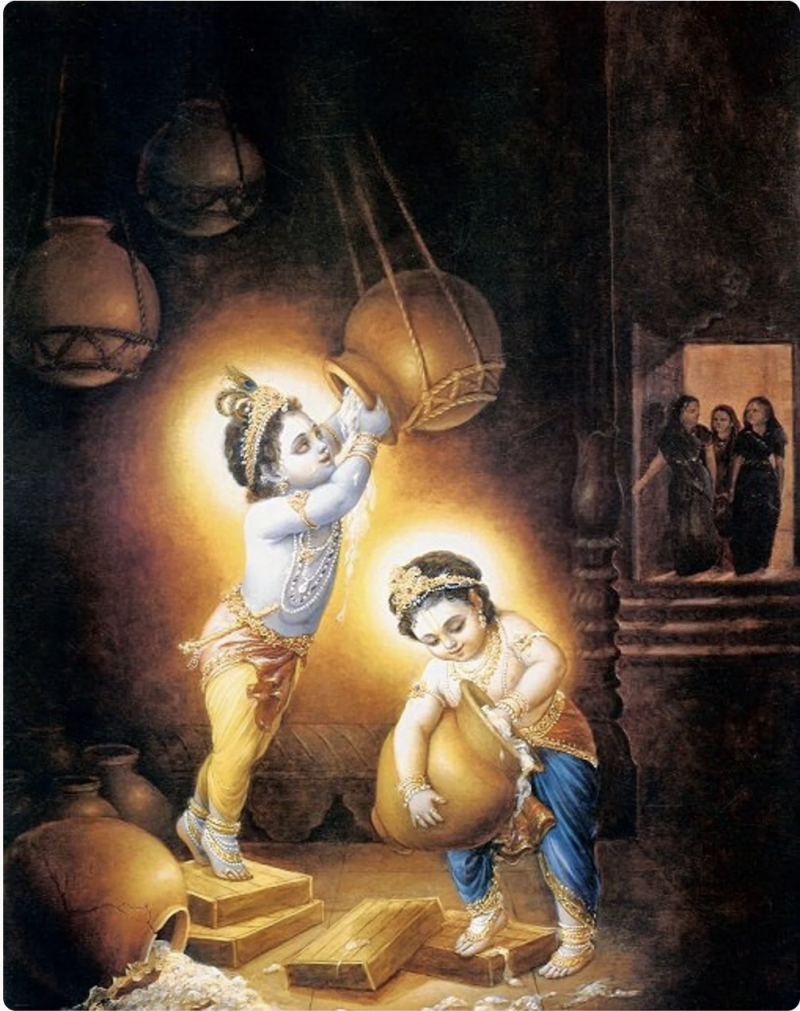
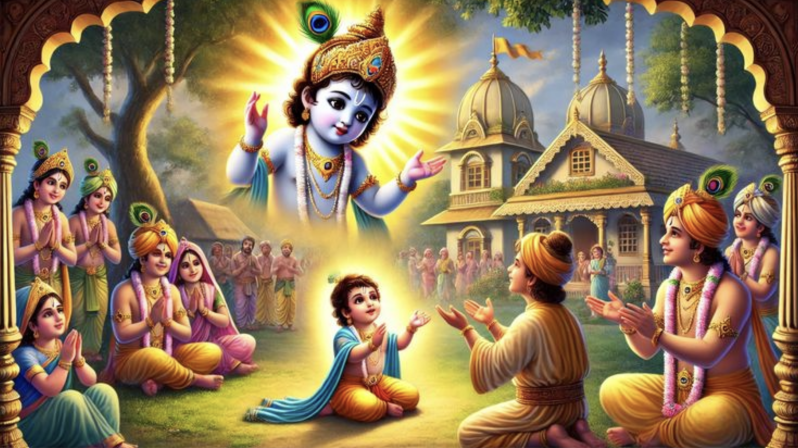
On the earth we will speak of God incarnating in human form. As Krishna, for example, we will speak of the delightfully mischievous child; as he grows up He becomes the endearing friend of all,, and the protector of the meek. In full youth He'll be the lover of the maidens of His village who all fell in love with Him, and as a full-blown adult He will deliver the timeless Bhagavad-gita. His life is not just a tale but a series of lessons filled with charm and mystery. From stealing butter to lifting a hill, the various episodes in Krishna's life display playful spirit, and compassion for humanity.
Let’s take the episode of child Krishna lifting the Govardhan Hill as an example. To this day the locals believe it actually happened historically. For everyone else it's a tale. Practicing devotees, however, hold it to be literally true on account of the training they have received to perceive how such a feat was ever possible. Imagine, an eight-year-old boy picking up an entire hill with the pinky of his left hand. A God with a sense of humor, that is. Humour, at last! This is something that had been missing in other versions of God; as if humor hardly fitted in with the idea of God. Yet, in the case of Krishna, it does fit in.
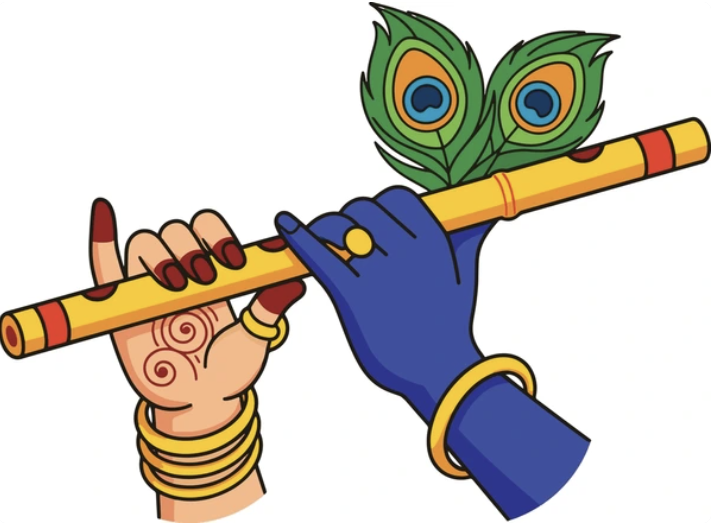
The full pastime is told that King Indra, Deva of thunder and rain, had felt offended when mischievous Krishna had convinced the villagers to stop worshipping him as the supplier of rain to their crops and cows. He ordered his mega cloud to break loose and pour down a deluge on the village to cause unprecedented floods. Turning to Krsna as their unfailing protector, the villagers immediately saw Him casually bend down and pick up the nearby hill to use it as an umbrella. Krishna held it for seven days, playing His magic flute with his other hand. Thus humbled and bewildered, Indra in turn bent down, in submission to the One he’d now realized was the Surpeme Lord incarnate. Ever since, polytheist hindus have learned their lesson that there is but one Supreme Personality of Godhead. The many gods of Hinduism, being but His humble servants, are to be seen on a par with the ministers of a government serving under one president.
One may object ---but what about other incarnations than Krishna ---Rama, Shiva, Nrishimha, or Buddha? Aren’t they other Gods in a polytheist pantheon? No, they aren't. Unlike the plethora of Devas (who rule the universe at all times), incarnations of the Supreme Being appear one at a time --“Whenever and wherever there is a decline in religious practice, and a predominant rise of irreligion—at that time I appear Myself.” (Bhagavad-gita 4.7).
Hence, "Leela Avatars" are successive manifestations of the one and only Unique God throughout history. Hindus consider Jesus Christ as an Avatar ---The Son of God, an incarnation of “The Father” (the only one for the Christians).
Okay well, so far earthly Divine Plays don’t seem that blissful after all. While Krishna lifting a hill to rescue his village folks may be fun, Jesus dying on a cross to redeem mankind cannot be called playful by any stretch of the imagination. It is ultimate self-sacrifice in the darkest possible scenario. It is God taking full responsibility for humanity’s misuse of free-will. It is the proof of how far God was prepared to go to demonstrate His Love. This is something yet unseen in Indian Leela theology…
There is one exception. In 16th Century Bengal there lived an outstanding saint whose name has spread to every town and village throughout India, and beyond ---Sri Chaitanya.
Sri Chaitanya was married to Vishnupriya, an exceptionally virtuous young lady he loved dearly, and who loved him as much. When he turned 24, however, circumstances were such that Sri Chaitanya had to leave his town of Navadwip and renounce the world. He travelled to South India and chanted the holy names of Krishna loudly. On hearing his chant, many thousands of people quickly joined in unison:
“Hare harayana nama krsna yadavaya namah… Hare Krsna Hare Krsna, Krsna Krsna Hare hare…”
Sri Chaitanya spent his life chanting these and other mantras which became known in the four corners of the land. Chaitanya always remembered his chase Visnupriya, and so did she. Indeed their love ---however tragic on the surface— became a prime example of a couple's self-sacrifice, who surrendered their own happiness for the sake of what is known today as the movement for Krishna Consciousness. Not surprisingly, the central theme of this practice is Love in separation (vipralamba). Central also to the monastic tradition of John of the Cross and Theresa of Avila in Europe, coincidently at the same time period. The theme of mystic separation gave us the expression “the Dark Night of the Soul”.
It’s a practice where the devotee finds him/herself in limbo, having left the world behind them and not being yet in the presence of God. Sri Chaitanya spent le last 18 years of his life in that condition, scratching his face against walls while calling out, He Krishna! He Krishna!
This is when Divine Play turns to tragic drama. Ostensibly that is.
TO BE CONTINUED