The Divine Couple Across Cultures
(Continued from Page One in the Home page)
PAGE TWO
As for contemporary Christianity we may wonder what became of the biblical Divine Couple of Solomon. While Asherah and Yahweh are no longer venerated in any temple worldwide, a masculine over-representation of Divinity has clearly become the norm in most cultures. Is it a typical case of sexist discrimination, to use a modern expression? You decide. More surprising, perhaps, is the apathy of modern Christians --male and female alike-- in noticing the absence of a consort alongside the Heavenly Father.
The advent of Jesus Christ has somewhat changed the game regarding the solitary God. The vision of a Holy Trinity has emmerged. By empregnating an immaculate woman ("without sin") with His Holy Spirit, the heavenly Father --first Person of the Trinity-- has exalted her as the Mother of God-the-son -- the second Person. Raising womanhood to such a lofty status had never been seen before Christ, all abrahamic traditions combined. Even superman can't compare to 'the Mother of God", a role that the Virgin Mary continues to play through the various marian apparitions occuring around the world. The eariest one was Our Lady of Guadalupe in 1531, the most famous being Our Lady of Lourdes (1858) and Our Lady of Fatima (1917). In modern times "Our Ladies" have been seen by tens of thousands around the world --in Asia, Africa, South India, the Middle-East, South America, and the United States. If you think such apparitions are spun by collective allucinations (also called mass delusion) of crowds of Christians, think again. In August 2000 in the Egyptian city of Assiut, over one million Muslims saw a Virgin Mary standing above a church. Although the event has been extensively strutinized and documented in the press and in hundreds of videos over a period of several months, the Western media chose to ignore it. Perhaps they preferred to relay news about wars than cover an event that united millions of people in prayer. The apparition of Assiut was not an event against anyone but for everyone. In the Qu'ran Mary is mentoned more times than in the New Testament. She is the woman chosen above all others. When the muslims saw that Lady of light above the church of Assiut, she was no foreign icon to them --they saw their own Mariam. (Click for the article Maryam bint Imran below *).
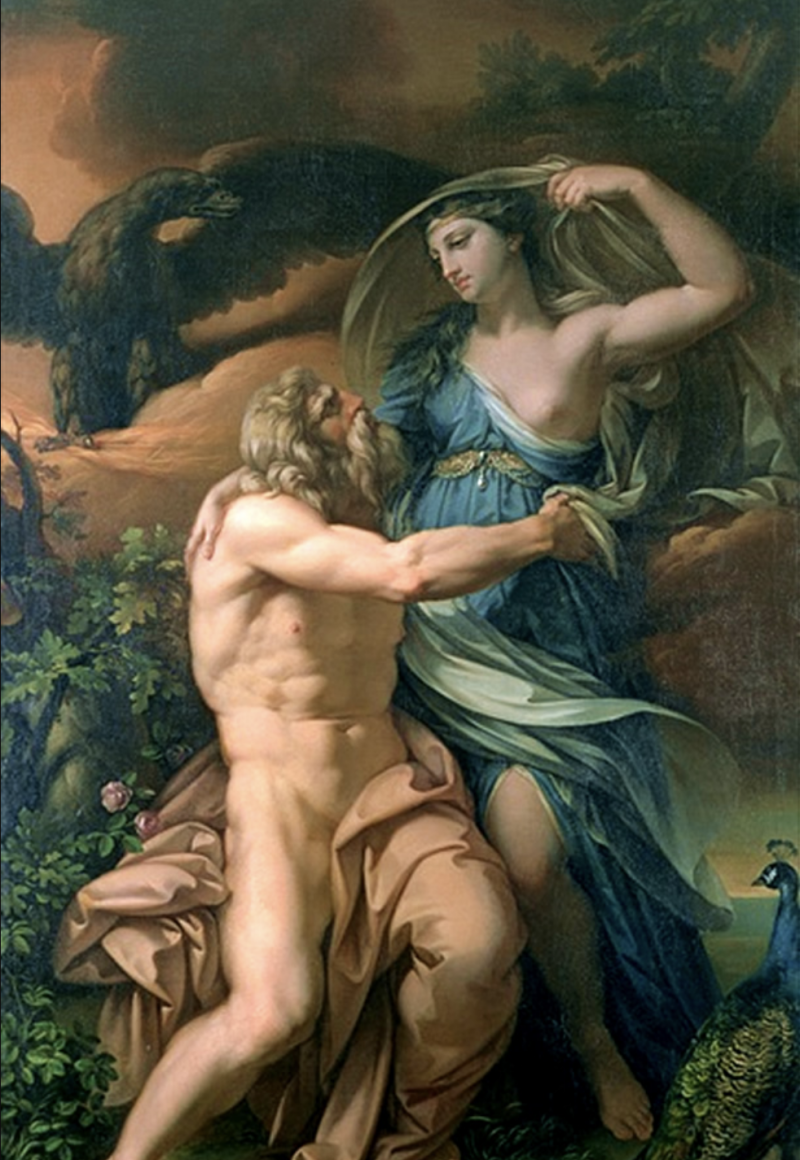
Juno & Jupiter (by Gavin Hamilton)
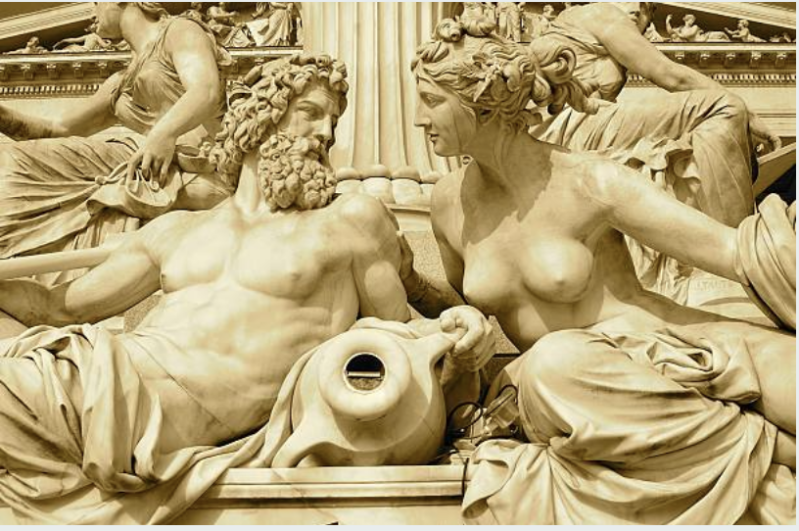
Hera & Zeus (in the Parliament of Austria)

Pagan Great Rite

Magdalen & Christ (after the resurrection)
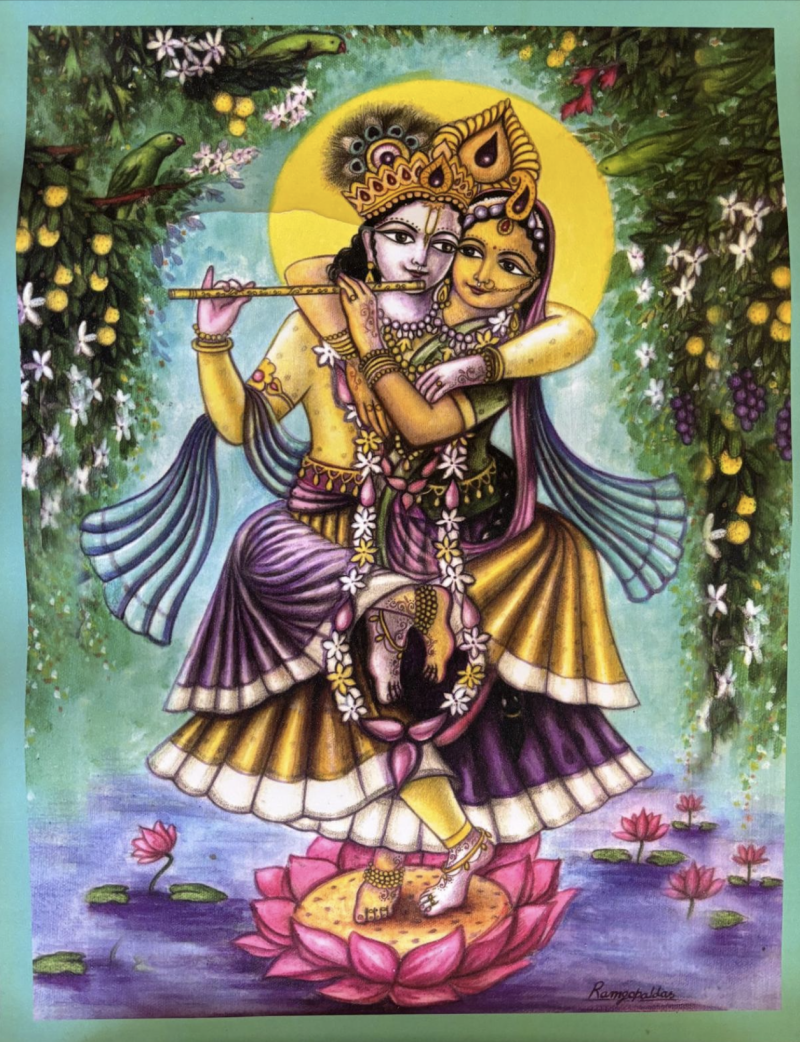
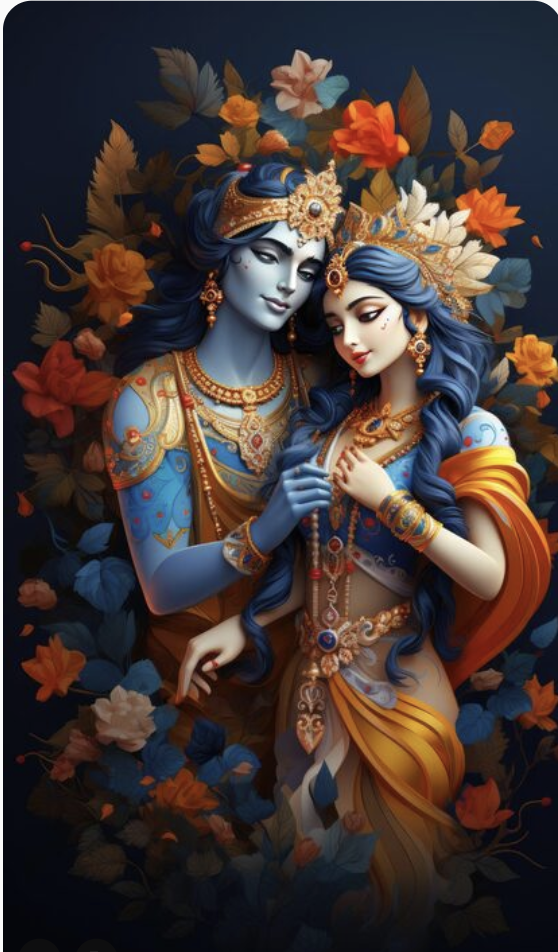
Radha & Krishna in mystic union
PAGE FOUR
Whether the Vatican and theologians will ever endorse this conclusion is another matter. Recognizing Mary as a human incarnation of the Eternal Feminine, the Divine Consort, the Taoïst Yin, counterpart of the Yang? The stakes are high. Hence Doctrine and theology are not always best abilitated to give such answers. So far ---as is often the case--- the faithful, together with the penomenon of divine apparition, have taken the lead. Their “consecration prayer to Mary” tells far more than prayers to any other saint in history:
“My Queen and my Mother, I give myself entirely to you; I consecrate to you my eyes, my ears, my mouth, my heart, my whole being without reserve. Keep me, guard me, as your property and possession. Amen." (consecration prayer to Our Lady of Lourdes)
Now comes the crucial question ---is Mary the human incarnation of the Eternal Feminine, the Taoïst Yin, counterpart of the Yang?
Let's suppose we answer YES! to this crucial question, an immediate query would follow: "what kind of love unites the Heavenly Father and the Mother of Jesus. Christian theologians often brush off the subject by arguing that God is beyond gender considerations (as it is argued that even angels have no sex). Gender would be the exclusive domain of human beings (and animals). While the expression "God the Father" appears eminently masculine, it is presented as a figure of speech to make the concept accessible to us. By the same token the phrase "God made man in His own image" is interpreted as being a metaphor. This is how, perhaps conveniently, the question, "But in whose image was woman made", becomes a mute point.
Generally, conservative Christians are known to favor literal meanings. Literally, "God the Father" is a paternal figure, a person. In the case of God the Father, however, the literal meaning poses a serious problem: where can we find a Mother Goddess who, before being Mother, is Eternal Consort? Hence the question was never acknowledged by any Christian institution ---the literal meaning being left aside this one time.
Below, a passage from Jayadeva's Gita Govinda. Krishna scorns Radha in jest.

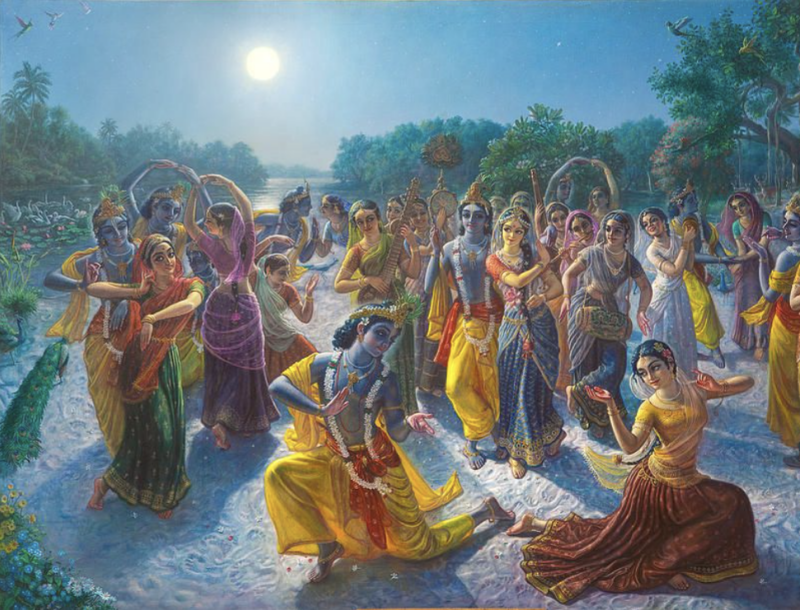
The Rasa Danse of Radha-Krishna and the Gopis

A carmelite nun being wedded to Christ
PAGE THREE
In August 2025 in Lourdes, Charles-Raphael Payeur, Bishop of the Catholic Church of Quebec, asserted at a seminar on the Marian conception that, "A woman can hardly do better than to be raised to the position of 'Mother of God' ".
Indeed, this statement brings up the awkward fact that the Virgin Mary ---while being raised to the loftiest status possible--- has never been considered on an equal footing with God, as a Goddess would be. She was married to Joseph, a carpenter, leaving the Holy Father with no consort, either divine or human. Elevating a woman "to the threshold of Divinity" is certainly unprecedented and the Roman Catholic Church has distinguished itself from other Christian institutions by exalting a mortal being to such a postition. Yet Catholics don't worship Mary. When they're asked an explanation, the most common answer is, "We pray to her, but only worship the Trinity." The Eastern Orthodox hold a similar view, --"Her position gives her incredible influence. We hold her in high esteem and give her the reverence she deserves as the bearer of God." Finally, the Protestants, while honoring Mary with folded hands, have always been opposed to even praying to her, an act they also reserve to the Holy Trinity. Each to their own.
A point of interest is that Mary's clout has considerably increa-sed in time --not only among Christians-- on account of Our Lady's various apparitions. In recent time more people pray ---and indeed worship her--- to the point of making her "Spouse of the Holy Spirit." This is a first, and it carries natural authority on account of Mary being impregnated by the Holy Spirit.
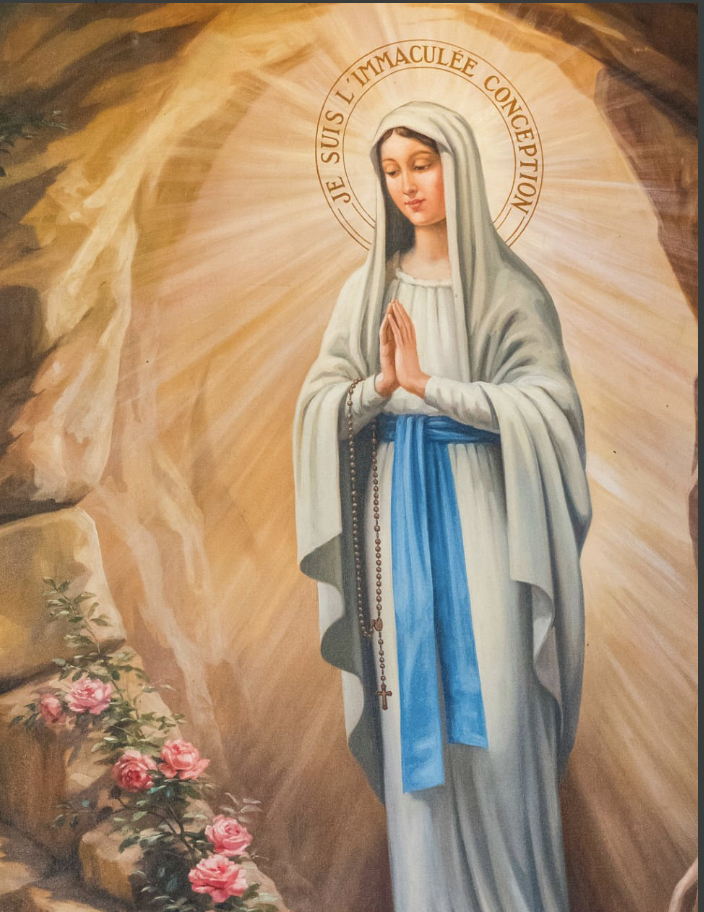
Our Lady Of Lourdes

Marie and Child Jesus

PAGE FIVE
Another fair question arises: what exactly would be wrong with the God of Love to experience a loving union with His Feminine Counterpart? For the defenders of the Divine Couple the time has come for "In His image" to become "In Their image," Because what man is in the image of God, woman is... in the image of Goddess. It would be that simple.
Let us now turn to the Divine Couple of Vaishnavism, one of the three major Hindu traditions. In the Vedic conception, God and Goddess love each other tenderly. Nay, passionately. Is it surprising? Think about it ---“On earth as it is in heaven!” If we humans are endowed with such a sweet privilege as erotic love, how would our Source be deprived of it?
What if we were the ones deprived of entering such a well guarded secret? Upon examination, there are good and bad reasons for keeping the secret. Imagine a carefree infant stepping into its parents’ bedroom during their intimate moment. "Mummy and daddy are fighting! What will become of me?" To be sure, the parents must avoid such intrusion at all cost. And so has the Divine Couple done with us unwitting children. Apart from rare authors like Salomon, Teresa of Avila, St. John of the Cross, and Jayadeva, hardly any mystics have ventured to describe intimate moments between God and Goddess. If such revelations exist at all, it is for the sake of that child-like inner instinct in our souls to enter a fraction of the Divine Couple's mystery.
In Vaishnava traditions the intimacy of God-Goddess is expressed in poetry (see excerpt on left). Their passionate interactions are described, only up to a point. It is safely coded, reserved as it is for few initiates. The custom is for the faithful to rejoice in just 'knowing" that God and Goddess love each other dearly. It is also legitimate for those wishing to enter into such mysteries to make a careful connection between their own perception of physical love and the sublime exchanges within the divine Source. Yet the tradition emphasizes that divine eroticism has little ---or nothing--- to do with mundane eroticism. At best, human love is viewed as a perverted reflection of divine love.
In the excerpt on the left taken from Jayadeva's Gita Govinda, we're introduced to the idea that Krishna may have more than one beloved. Yes, there are countless souls aspiring to unite with God. Among them the purest souls are called Gopis; they are close female assistants of Radha, Krishna's supreme beloved. Picture Radha as the sunshine, and Her "gopi-friends" as sunrays. As such, we're all potential spouses of the sunlike God. This is not just a Hindu concept as some readers might think. Famous Carmelite mystic St. John of the Cross describes what he calls "spousal prayer" as, “a total transformation in the beloved, in which each surrenders the entire possession of self to the other. The soul thereby becomes divine, insofar as is possible in this life. Just as in the consummation of carnal marriage there are two in one flesh, as sacred scripture points out (Gen 2:24), so also when the spiritual marriage between God and the soul is consummated, there are two natures in one spirit and love”.
In this way the carmelite practice, for both man and women, aims at getting their members wedded to God in the person of Christ. This suggest a great many brides of Christ enduring eternally in the afterlife. The Vaisnava Hindus have the same vision of amorous union with Krishna for each gopi candidate. This is not to say that every christian or vaishnava devotee aspires for romantic love with God. Quite the opposite, only a handful do. For the vast majority of us love for God is felt in one of the following moods (rasas): as a contemplative, as a servant, as a friend, or as a parent.
We will not list every religious culture's specific conception of divine amour; we might just presume each one has some form of equivalent. The object of this article was The Divine Couple Accross Cultures and we think enough evidence is there to conclude that many religions, traditions, and even civilizations have developed, at least at some point of their history, the notion of a Divine Couple, and of spousal, amorous love for God.
NOTE: Kindly feel free to make comments or put questions at the bottom of the home page in response to the subject of this article.