Teresa Of Avila
Teresa of Ávila was a Spanish Camellite nun whose writings and mystical experiences made her a major figure in Christian spirituality. She founded a reformed and autonomous branch of the Carmelite Order, which spread rapidly throughout Europe and then the world. She was soon canonized and, in 1970, became the first woman to receive the title of Doctor of the Catholic Church. Her spiritual influence, combined with that of Saint John of the Cross, was very strong from the 17th century onward, and she remains a reference point far beyond her monastic community and Christendom. After her death, her body, considered incorruptible, was exhumed several times. Bodies that undergo little or no decomposition after death are said to be incorruptible, a state that the faithful perceive as a sign of holiness.
Orison
Before continuing, it is important to define the practice of silent orison, to which Thérèse was a fervent follower. Silent (or contemplative) orison is a form of silent prayer practiced in various Christian monastic orders. It is a time of awakening to the divine presence in the heart, which includes a loving dialogue to reach divine contemplation and allow oneself to be transformed. Having experienced spiritual graces during her orisons, Thérèse confided in her confessor to find out if they came from God or the devil. After listening to her, he declared that the so-called graces came from the devil. This caused Teresa great torment. After several years of repeating the same explanation, the confessor finally advised her to consult other priests, and she chose to accept one of them as her new confessor.
The following year (1556), Teresa began to experience intense spiritual graces, and was conforted to learn that they came from God, not the devil. She recounts having her first vision as a glimpse of hell. Under the new direction for six years, she states in her autobiography receiving great heavenly graces, including a vision of the risen Christ, intense experiences of spiritual ecstasy, and episodes of levitation from which she implored God to deliver her.
Teresa was encouraged to implement her plan to reform the Carmelite Order, which she had conceived at that time: she wished to found a monastery in Ávila, scrupulously respecting the Order's rule, which included the obligation of poverty, solitude, and silence. She was also asked to write an account of her life.
The Interior Castle
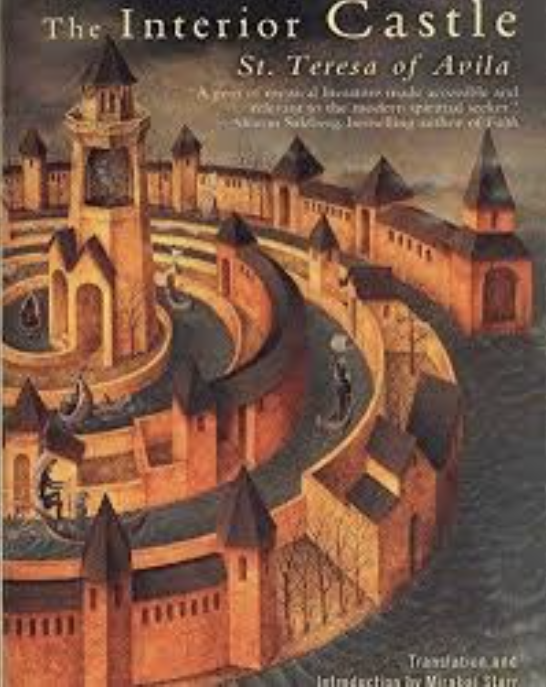
In her major work, The Interior Castle (1572), Teresa emphasizes that mystical contemplation consists of "extraordinary gifts that God grants only when and to whom He wills." It is only when the soul reaches the fourth mansion (out of seven ascending degrees of spiritual progression) that the passage from the natural to the supernatural takes place. Supernatural orison, however, is a free gift from God, who sometimes grants it even to souls whose spiritual state is still imperfect.
In her autobiography published in 1565, Teresa recounts experiencing a transverberation: “I saw an angel near me, to my left… He was rather small, very beautiful, with a face so purple that he resembled those angels whose colors seem to burst into flames… I saw in his hands a golden blade, with a flame at its tip. It seemed to me that he thrust it into my heart several times and that it reached my very core. When he withdrew it, I felt as though everything was carried away with it, leaving me completely ablaze with a great love for God. The pain was so intense that it made me sigh, and the sweetness that this immense pain brought me was so overwhelming that one could only wish that it would continue, and that the soul would be content with nothing less than God. It is not a physical pain, but a spiritual one, even if the body participates in it somewhat, and even very strongly. I wish His goodness would reveal it to those who might think I am lying… During the days when I experienced this, I wandered as if dazed. I wished neither to see nor speak to anyone, but to be consumed by my grief, which was for me one of the greatest glories known to His servants.
Teresa defines orison as "an intimate communion of friendship with God, knowing that we are loved by Him". Teresa of Lisieux echoes this definition as, "a cry of gratitude and love in the midst of trial as well as in the midst of joy."
In her work "The Degrees of orison," Teresa synthesizes different levels of orison in a spiritual progression of the soul. The metaphor is that of a garden that one strives to water through various efforts made by the believer. She describes different types of orison at length in her autobiography, in parallel with the seven levels of The Interior Castle:
- Meditative Orison (Teresa uses the image of a gardener drawing water from his well with a bucket): this corresponds to the first three mansions of the Interior Castle. This meditation can be practiced using devotional images in order to know and appropriate the qualities of the Lord, to gradually make them one's own, and to conform to Him.
- Orison of Remembrance: memory, imagination, and intellect are calmed; the mind is tranquil; the soul knows it is loved even if it feels nothing. This becomes supernatural when God gives a gift to the soul, gathers it entirely within Himself, and concentrates it.
- Orison of Quietness (Teresa gives the image of a gardener using an irrigation wheel to draw water effortlessly): This is the fourth mansion, which "is like suddenly finding oneself in unexpected joy. [...] God gives the gift of raising the person up a mountain to experience His intimacy. [...] The will receives a great reward [...], it is ablaze with love."
- Contemplative Orison (Teresa uses the image of water flowing naturally from a stream due to gravity): the will is anchored in God.
- Orison of Union (Teresa uses the image of rain; the gardener no longer has anything to do): 5th, 6th, and 7th mansions. These are the encounters of the soul with the Bridegroom (Christ), leading up to the betrothal and spiritual nuptials (image of the couple and marriage.
Orison also allows the soul a better "self-awareness", where one identifies one's faults, weaknesses, and baseness, and can thus correct them.
Development of the Faculties
While some psychiatrists have pointed out similarities between the character traits of great contemplatives like Teresa and "pathological states" such as hysteria, which typically produces a "decline," whereas cases caused by the action of God produce a development of the faculties. The best example of this is Teresa who, without formal education, wrote works of the highest theological caliber that earned her the title of Doctor of the Church (She was the first woman ever to receive that distinction). The other Teresa ---Saint Teresa of Lisieux--- left school at the age of

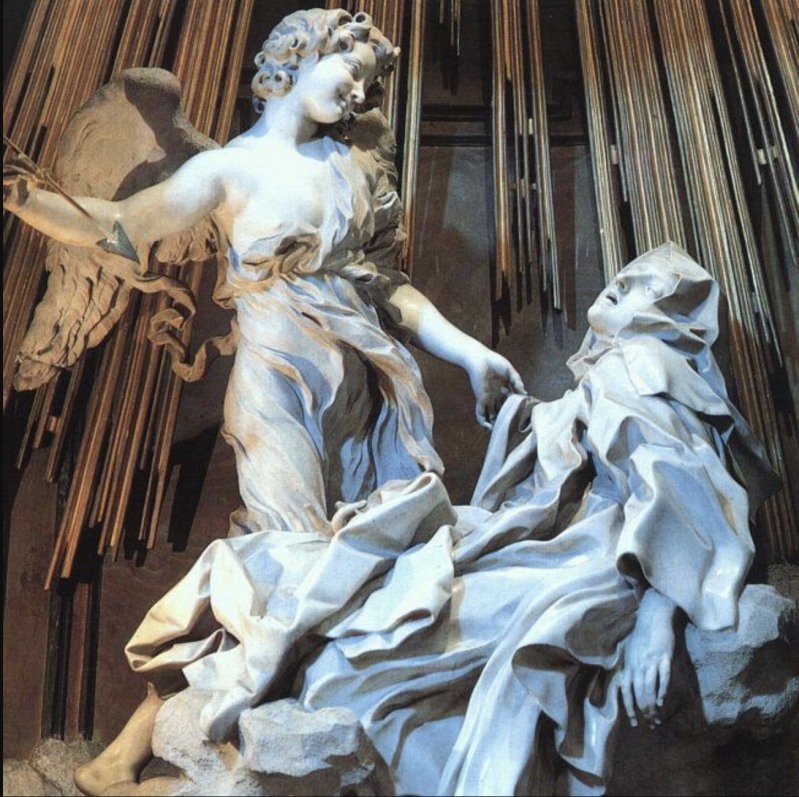
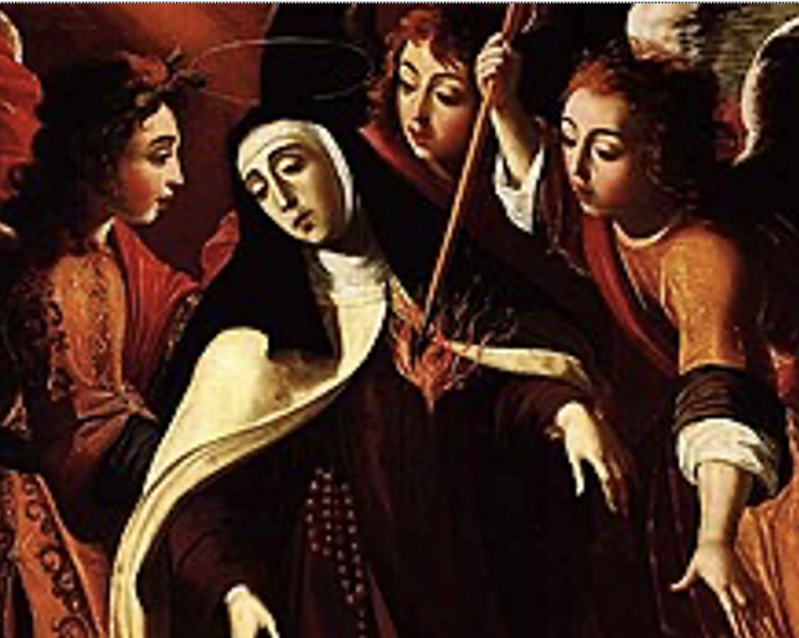
The transverberation of St. Therese by Joseph of Obidos

16 (having been a perfectly average student) to enter the Carmelite order, and went on to author a large number of poems, plays, and above all her narrative "Story of a Soul", which sold 500 million copies (and also earned her the title of Doctor of the Church).
In those days many believed that strong apostolic activity could not be sustained without a significant period of solitude and contemplation. Indeed, contemplation is intrinsically linked to an active apostolate, and, according to Teresa, it reaches its ultimate perfection in action.
Teresa's path of orison contains several difficulties that are said to hinder progress:
- Distractions that cause one to abandon orison.
- Pride in seeing oneself as a special being.
- Periods of contemplative dryness (also called "the dark night of the soul" by St. John of the Cross).
To overcome these difficulties, Teresa of Avila recommends patience, perseverance, obedience, and the guidance of a spiritual director.
Libro de la vida
The Book of Her Life (Spanish: Libro de la vida) is a largely autobiographical work recounting the life of the saint up to the very first foundations of convents (1566). Teresa explains her spiritual journey, her conversion, and the spiritual experiences that transformed her life. This is why some consider the book more of a "spiritual guide" than a simple autobiography. The publication of the document was long delayed by the seizure of the manuscript by the Inquisition, which, despite a positive opinion, blocked the work's dissemination for many years. Furthermore, several modified versions were written by theologians, leading those in charge to consider simply burning the original work. Teresa remained unmoved by this threat. Fortunately, the idea of burning Teresa of Avila's Book of Her Life was abandoned. Once the first edition of the work was published, it was quickly translated and distributed in various countries, and it is regularly reprinted worldwide. On the occasion of her five-hundredth anniversary in 2015, the reading guide to The Book of Thérèse's Life states: “No sooner have we opened the volume of Saint Thérèse's works than we come across the extraordinary prologue to The Book of Her Life, in which she warns the reader not to forget the obscure part of her person, which she is not permitted to speak of, for she is only allowed to write about her way of praying and the graces she received. This is a statement that immediately sets us apart from conventional hagiographic style and brings us back to the authenticity of a Christian life in a continual state of conversion. If Thérèse writes this, it is precisely so that no one will feel excluded from the possibility of following her path and receiving graces similar to those she experienced.” “In the third part of her book, Teresa declares: ‘Now a new life begins. The one I recounted first was my own life; the one in which I then spoke of the various states of prayer is, if I am not mistaken, the life of God in me.’ Since this article does not aim to reproduce the classic biography of Teresa of Avila, we can only recommend it to anyone who feels inspired to read it.”