DOGMAS
Dogma means the doctrine or belief in a religion or a political system. The literal meaning in ancient Greece was "something that seems true." These days, dogma is more absolute. If you believe in a certain religion, philosophy, or system, you believe in its core assumptions, its dogma.
Religious dogmatism is frequently associated with the Christian dogma that arose in Europe over the past two millennia. For example, Catholics hold that God is a Holy Trinity and Jesus was conceived by immaculate conception when Mary was impregnated by the Holy Spirit.
Dogma can also have a negative connotation, as by asserting opinions in an arrogant manner. You might look down on others who don't live according to those same morals and are likely to be intolerant of other beliefs.
Of all people Albert Einstein was never considered dogmatic. Yet, when asked if he accepted the historicity of Jesus, he replied, "Unquestionably!” Does this imply that Jesus came to save the world? Certainly not. Likewise holding Mohammad as the messenger of Allah, Krishna as the origin of other Divine Incarnations, or Jesus as the Son of God, is not dogmatic. It is holding one of these as the one and only truth and all others as false that constitutes dogma.
We sometimes hear that all religions are equal, which may be right in that they all propose to lead to the Absolute. However, certain religions are more prone to dogma than others. The tendancy to proselitize forcefully with the aim of bringing the world under your own faith is the epidemy of dogmaticism. Historically, Buddhism, Hinduism, or Judaism are considered least dogmatic in the sens that they have never be found to predicate with the aim of mass conversion, overt or covert. In fact some doctines hold that unless you were born into their faith, you cannot become a member through conversion. This may in fact be another form of dogma. ---------->>>


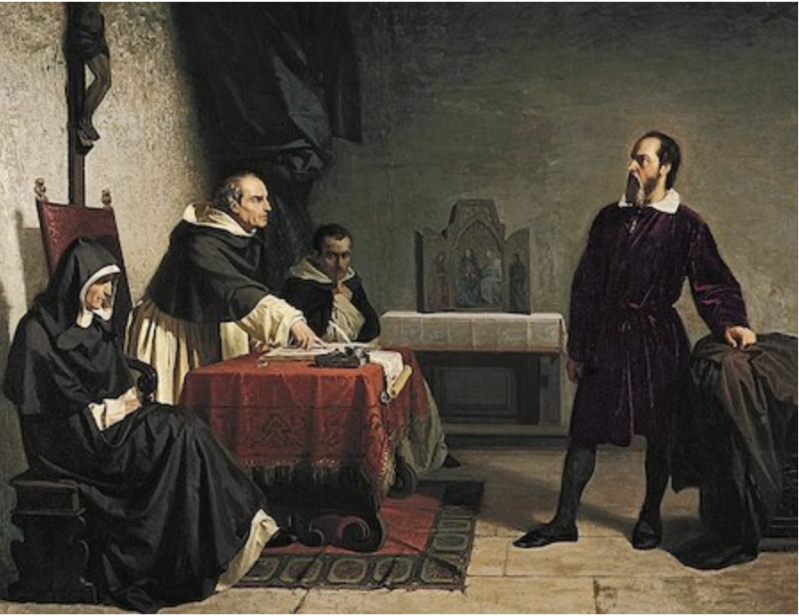
Galileo facing the Roman Inquisition


The Amish resistance to modernity
A more modern form of dogma is the refusal to accept the evolution of one's doctrinal view. God’s revelation at a given point in time remains set for all times. The Amish community is often cited as an example of this in their refusal to adapt to modernity ---motocars are banned for ever and the Amish only move about in horse-drawn carriages. So is violence in any form banned. An Amish cannot hit back at an assailant’s aggression --- they must tolerate and let the attack unfold with the faith that God will protect them.
While such behavior may seem fanatical ---if not outright crazy--- to outsiders, it cannot be presumed to be dogmatic so long as the adept is acting with the intimate conviction that non-violence must prevail in all cases, or that motorized inventions are incompatible with Biblical teachings.
TO BE CONTINUED SHORTLY