
This article contains excerpts from Wikipedia that have been modified for conciseness)
The New Age Movement is a range of spiritual practices and beliefs that rapidly grew in Western society during the early 1970s. Its highly eclectic and unsystematic structure makes a precise definition difficult. Although many scholars consider it a religious movement, its adherents typically see it as spiritual or as a unification of mind, body, and spirit, and rarely use the term New Age themselves.
As a form of Western esotericism, the New Age drew heavily upon esoteric traditions such as the occultism of the eighteenth and nineteenth centuries, including the work of Emanuel Swedenborg and Franz Mesmer, as well as Spiritualism, New Thought, and Theosophy. More immediately, it arose from mid-20th-century influences such as the UFO religions of the 1950s, the Counterculture of the 1960s and the Human Potential Movement. It became a major movement in the 1970s, at which time it was centered largely in the United Kingdom. It expanded widely in the 1980s and 1990s. By the start of the 21st century, the term New Age was increasingly rejected within this milieu,with some scholars arguing that the New Age phenomenon had ended.
Despite its eclectic nature, the New Age has several main currents. Theologically, it typically accepts a holistic form of divinity that pervades the universe, including human beings themselves, leading to a strong emphasis on the spiritual authority of the self. This is accompanied by a common belief in a variety of semi-divine non-human entities such as angels, with whom humans can communicate, particularly by channeling through a human intermediary. Typically viewing history as divided into spiritual ages, a common New Age belief posits a forgotten age of great technological advancement and spiritual wisdom that declined into periods of increasing violence and spiritual degeneracy, which will now be remedied by the emergence of an Age of Aquarius, from which the milieu gets its name. There is also a strong focus on healing, particularly using forms of altenative medicine, and an emphasis on unifying science with spirituality.
The dedication of New Agers varies considerably, from those who adopt a few of New Age ideas and practices to those who fully embrace and dedicate their lives to it. From the 1990s onward, the New Age became the subject of research by academic scholars of religious studies. Yet it remains among the most disputed of categories in the study of religion. There is no central authority that can determine what counts as New Age and what does not. Many of those groups and individuals who could analytically be categorised as part of the New Age do not apply the term New Age in reference to themselves.
1960s
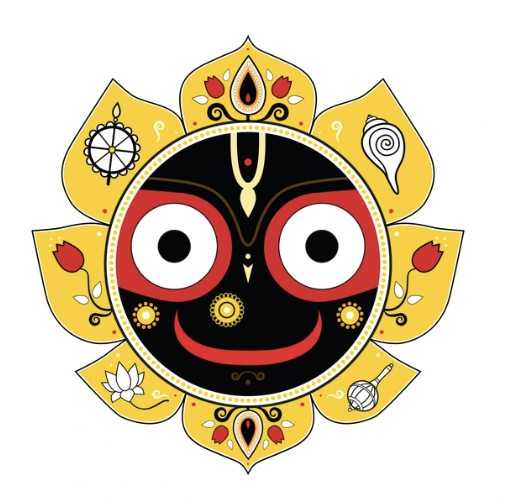
From a historical perspective, the New Age phenomenon is most associated with the counterculture of the 1960s. According to author Andrew Grant Jackson, Beatle member George Harrison's adoption of Hindu philosophy and Indian instrumentation in his songs with the Beatles in the mid-1960s, together with the band's highly publicised study of Transcendental Meditation, "truly kick-started" the Human Potential Movement that subsequently became New Age. The term 'Age of Aquarius' ----used in reference to a coming era--- was found within the counterculture, for instance on adverts for the Woodstock festival of 1969, and in the lyrics of “Aquarius", the opening song of the 1967 musical Hair. This decade also witnessed the emergence of a variety of new religious movements in the United States, creating a spiritual milieu from which the New Age drew upon; these included the San Francisco Zen Center, Transcendental Meditation, and the Hare Krishna Movement. George Harrison’s songs My Sweet Lord and Jaya Shri Krishna, together with his production of the band Radha Krishna Temple and their song Govindam, are examples of musical contributions that created the spiritual milieu.
Channeling
New Age literature often refers to benevolent non-human spirit-beings who are interested in humanity's spiritual development; these are often referred to as angels or spiritual guides. New Age angelology is nevertheless unsystematic, reflecting the idiosyncrasies of individual authors. The figure of Christ is often mentioned as a mediating principle between divinity and humanity, as well as an exemplar of a spiritually advanced human being.
A core belief in Channeling is frequent in the New Age millieu. It's the idea that humans beings, sometimes in a state of trance, can act "as a channel of information from sources other than their normal selves".
A notable channeler in the early 1900s was Rose Edith Kelly, wife of the occultist Alister Crowley. Another famous channeler in the early 1900s was Edgar Cayce, who was said to channel his higher self while in a trance-like state.
In the later half of the 20th century, Western mediumship developed in two different ways. One type involved clairaudience, in which the medium is said to hear spirits and relay what they hear to their clients. The other is a form of channeling in which the medium purports to leave their body allowing a spirit entity to borrow it and speak through them. The medium appears to enter into a cataleptic state, and the intonation of the voice may also change completely.
For many New Agers, some channeled messages rival world scriptures as sources of spiritual authority. Although the concept of channeling from discarnate entities has links to Spiritualism and spychical research, the New Age does not endorse their emphasis on proving the existence of life after death, nor share their focus of testing mediums for consistency.
Eclecticism and self-spirituality
The New Age places strong emphasis on the idea that individuals and their own experiences are the primary source of authority on spiritual matters. This reflects a world-view that is "radically democratic". This emphasis has led to ethical disagreements; some New Agers believe that helping others is beneficial while others hold that it encourages dependency and conflicts with a reliance on the self. In both cases personal growth is always emphasised.
New Age religiosity is typified by its eclecticism, generally holding that there is no one true way to pursue spirituality. New Agers develop their own worldview "by combining bits and pieces to form their own individual mix", seeking a spirituality without borders or confining dogmas. This approach has generated a common jibe that New Age represents "supermarket spirituality”, subscribing to a belief in a free market of spiritual ideas akin to free market in economics. As part of their eclecticism, New Agers, albeit being predominantly white Westerners, draw ideas from many different cultural and spiritual traditions from across the world, often legitimising their adhering to an underlying global unity.
Theology, cosmogony, and cosmology
A belief in divinity is integral to New Age ideas, although understandings of this Divinity vary. New Age theology exhibits an inclusive and universalistic approach that accepts all personal perspectives on the divine as equally valid. This intentional vagueness also reflects the idea that divinity cannot be comprehended by the human mind or language. New Age literature nevertheless displays recurring traits in its depiction of the divine: the first is the idea that it is holistic ---its parts are interconnected and can be explained only by reference to the whole--- thus frequently being described with such terms as an "Ocean of Oneness", "Infinite Spirit", "Primal Stream", "One Essence", and "Universal Principle". A second trait is the characterisation of divinity as "Mind", "Consciousness", and "Intelligence", while a third is the description of divinity as a form of "energy". A fourth trait is the characterisation of divinity as a "life force", the essence of which is creativity, while a fifth is the concept that divinity consists of love.------------>>
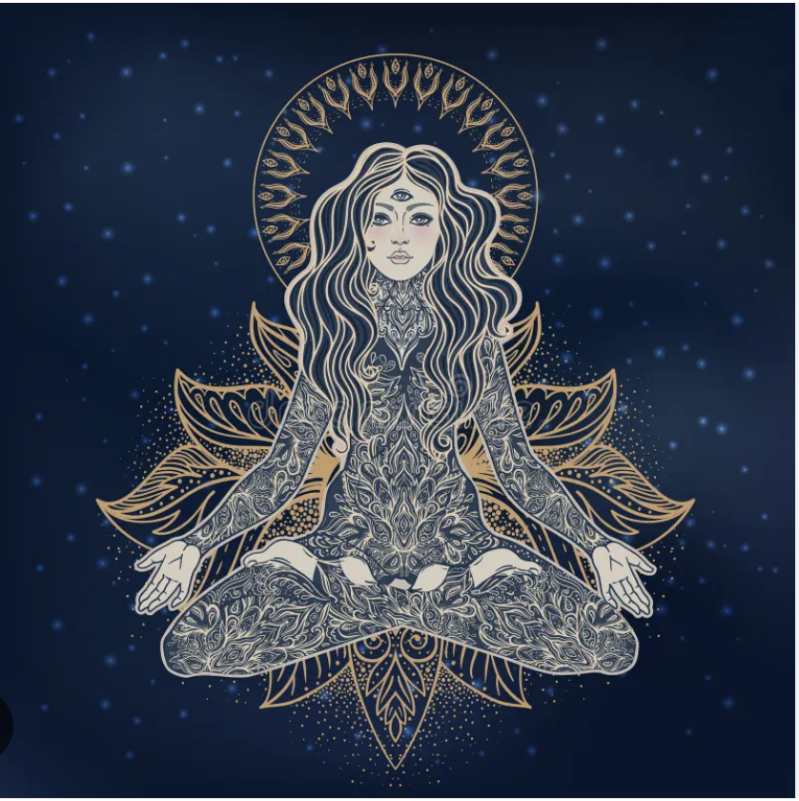

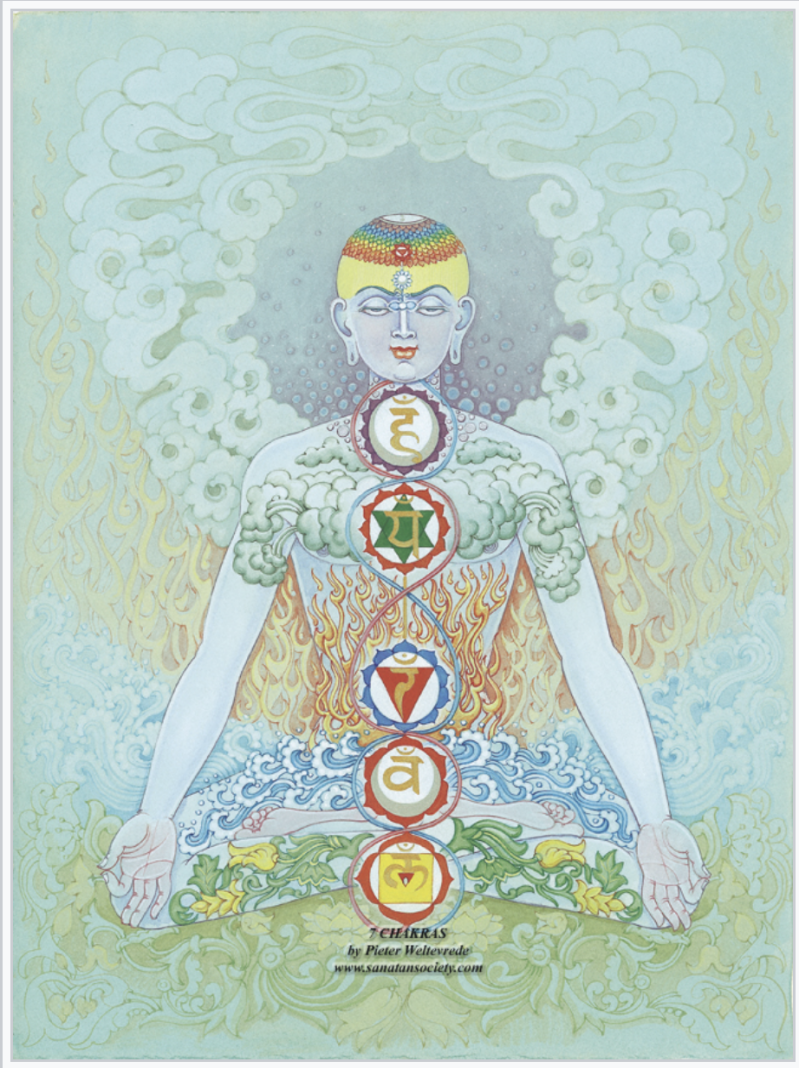
The seven chakras in New Age presentation
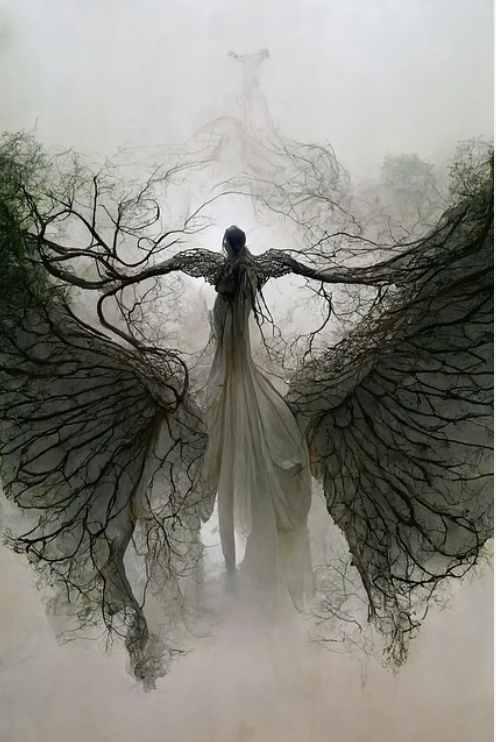
Semi-divine non-human entities such as angels, with whom humans can communicate.

MacLaine's journeys through New Age spirituality. Her candor about reincarnation, meditation, mediumship, and UFO made the book a best-seller.
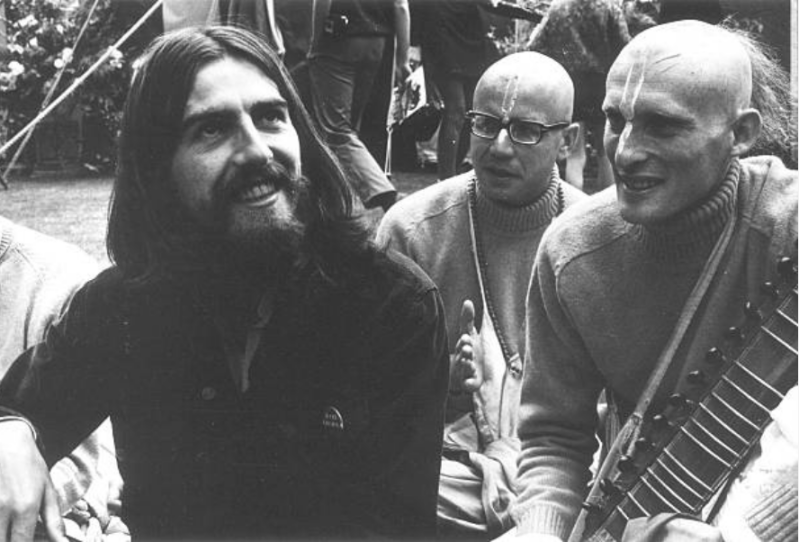
Beatle George Harrison with Hare Krishna devotees

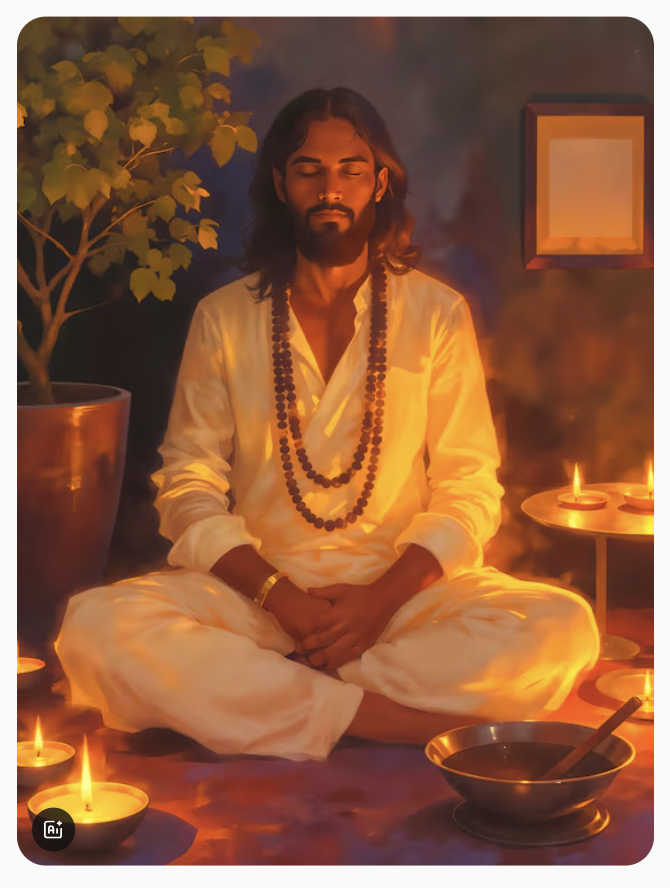
Trance-channeling medium

Oracle cards and crystals

A New Age healing session
Various creation myths have been articulated in New Age publications, outlining how the Ultimate Source manifested the universe and everything in it. In contrast, some New Agers reject both the dualism of the Christian division of matter and spirit and the reductionism of Cartesian science. The idea of holistic divinity results in a common belief that humans themselves are divine in essence, like "droplets of divinity" or "inner Godhead". Influenced by Theosophical and Anthroposophical, some New Age groups hold to the presence of a Higher Self that can connect with the divine essence through intuition.
Cosmogonical creation stories are common in New Age sources, with accounts reflecting the movement's holistic framework by describing an original, primal oneness from which all things in the universe emanate. Human souls once lived in a spiritual world but descended into this world of matter. The physical universe is seen as a meaningful illusion, which humans should try to use constructively rather than focus on escaping it. This physical world becomes "a domain for learning and growth after which the human soul might pass on to higher levels of existence. It's an ongoing process of evolution rather than a Darwinian evolution.
Ethics and afterlife
A common view of Newagers is that negative events are not the result of evil but are lessons designed to teach and enable you to advance spiritually. It rejects the Christian emphasis on sin and guilt, believing that these generate fear, which in turn hinder spiritual evolution. It also typically criticises the blaming and judging of others for their actions under the pretext that such blaming harms their own spiritual evolution. Constructive action is promoted instead, such as spiritual healing, repeated recitation of mantras, and affirmations carrying positive messages.
The question of death and the afterlife is not a pressing problem requiring an answer now. New Age literature commonly presents reincarnation as part of the soul's evolution, a reality that is usually treated as self-evident, with the explanation that such is the way cosmic justice is being enacted. The law of karma assures cosmic balance, without being specifically meant to either reward or punish one's past actions.
Much New Age literature on reincarnation says that part of the human personality perishes with the death of the body, while the higher Self —that which connects with divinity—survives so as to be reborn into another body. It is believed that the higher Self chooses the body and circumstances into which it will return, in order to use it as a vessel through which to learn new lessons. New Age writers like Shakti Gawain and Louise Hay express the view that humans are responsible for what happens to them, an idea that is considered empowering. At times, past-life regression are employed, with an explicit healing purpose. Some practitioners espouse the idea of a "soul group" or "soul family", who reincarnate together as family of friendship units. Through reincarnation, most New Agers hold that souls eventually return to their chosen Divinity, or to the impersonal Divine Energy.
In summary, the New Age are eclectic movements that rapidly grew during the 1960s and early 1970s in Western societies, and later beyond their boundaries. It relies on channeling and mediumship between human and non-human beings which provide spiritual healing and elements of divine revelation. New Age theology has a universalistic approach that accepts all personal perspectives on the divine as equally valid. A strong emphasis is given to the self-growth of individuals based on love, without depending on any formal dogma. The law of karma and reincarnation determins the evolution of souls within and beyond this life, with the notion of sin being set aside as a negative motivation based on guilt and fear. Individual responsibility for what happens in life is put forward over the curiosity for what happens at death or in the afterlife. Maharishi's phrase “Love everybody, serve everybody, and remember God”, in Ram Dass' seminal book "Be Here Now" could sum up the New Age attitude to life.