On The After-Life

You’ll find on Wikipedia one of their longest entries, all on the thorny issue of The Afterlife. There is listed practically every single tradition’s view on the subject, from metaphysical models to ancient religions ---Egyptian, Greek, Norse, Celtic, Abrahamic, Islamic, Jewish, Indian, confucian, thaoist, gnostic, spiritualist, Wicca, Zoroastrian, etc. Science and psychology are also listed for their insight. The entry is a hotchpotch of all possible conceptions, which Wiki calls “speculations” to remind the reader that none of it is necessarily true:
“The afterlife is a speculation concerning existence after death (…) In some views, this continued existence takes place in a supernatural realm, while in others, the individual may be reborn into this world and begin the life cycle over again through reincarnation, likely with no memory of what they have done in the past, until the individual gains entry to a spiritual realm.”
Rebirth being a separate issue, we’ll save it to a separate article. According to nearly all reincarnationist models rebirth never happens immediately upon death. The afterlife is always a supernatural period only mentioned in vague and concise form. Such mentions ---often at odds with each other--- are a mixture of tradition, spirit messages, and superstition.
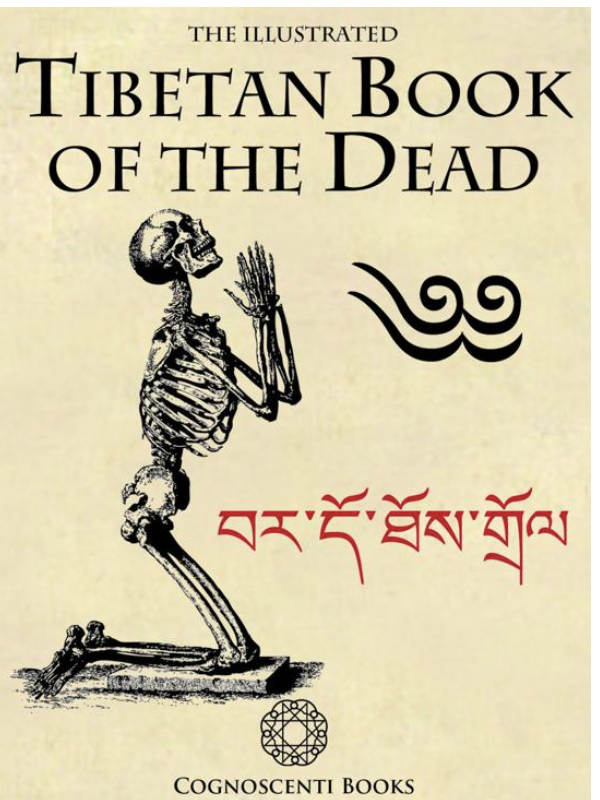
Famous exceptions are two detailed Books of The Dead, one Egyptian, the other Tibetan. Both provide the dying person with help in their upcoming afterlife. The Tibetan book, written on papyrus as early as 1550 BC, describes a series of six “bardos” (sanskrit for “gaps”), the fifth of which deals directly with the period between death and rebirth. In this bardo ---which begins immediately when consciousness separates from the body--- the pure, infinite expanse of reality is experienced. Bearing in mind that some 3500 years have passed before the modern subject of NDE has emerged, we may wonder how NDE descriptions, based as they are on the personal testimonies of people living in today’s reality, compare with those found in the Tibetan Book Of The Dead. See below an excerpt from the Dalai Lama’s own translation of the book:
"This naturally originating inner radiance Is the parentless child of awareness — how amazing! This radiant awareness has never been born and will never die — how amazing! Though it has seen buddhahood itself, it does not improve — how amazing! Though it is present in everyone, it remains unrecognised — how amazing! Still, one hopes for some attainment other than this — how amazing! Though it is present within oneself, one continues to seek it elsewhere — how amazing!"
And now is an excerpt from a recent NDE testimony, in Dr Moody’s “Reflections on ‘Life After Life", p.46-47 of the French edition:
“It happened immediately after the life review. I suddenly had the sensation of possessing knowledge of everything—of everything that happened since the beginning of the world and everything that would happen indefinitely. For a second, I had access to the secrets of all time, to the meaning of the universe, the stars, the moon—in short, everything. But the moment I chose to return to life on earth, this knowledge escaped me, and I retained nothing of it. (…). The memory of everything else that happened to me has remained very clear, except for that brief moment of absolute knowledge."
In Dr Moody’s words, "What has amazed me are the great similarities in the reports, despite the fact that they come from people of highly varied religious, social, and educational backgrounds.”
Dr Greyson, another leading researcher at the University of Virginia School of Medicine confirms that, “the core experience of NDE experiencers is much the same across cultures.”
If we compare the statements from the Tibetan book and from Dr Moody’s book, we can see that the post-mortem experience of an “infinite expanse of reality”, among others, is not only the same accross cultures, but the same for at least 3500 years, since the Tibetan book was composed.
What we have today is a growing research, both case-based and scientific, which promises to uncover further and further facts about the afterlife. Typically, there is a "life review", an assessment of the life just ended, which confers on it the much needed existential meaning that many of us have missed while living. It is-not the judgement we've been told about by religions, but a revelation of our mistakes and failures meant to be worked on and corrected. Then comes the discovery of a new set of circumstances where non-linear time and direct communication between living entities is the norm, bypassing the cumbersome medium of verbal language. A reality where movement occurs at the speed of mind, with spacial distances being reduced to nil; where physical bodies are replaced by etherial ones that no longer require to be seen with eyes but are sensed by intuitive vision.
“I was there with my grandparents, my father, and my brother, who had passed away years back. (…) Everywhere shone a beautiful light, full of vivid colors, nothing like on earth, indescribable. In the distance I could see a city with large, sparkling houses (…), gushing springs and fountains.


A city of light, that’s what I would be tempted to call it, and there was also heavenly music. I was told that if I went there, I would not come back. It was up to me to decide.” (Excerpt from Reflections on ‘Life After Life", p.46-47, French edition)
This description is representative of a large number of similar ones in testimonies reported by various researchers. They include meeting with loved ones, omnipresent glowing light that is not blinding, splendid cities and other-worldly countrysides, and heavenly music no one has ever heard on earth.
In fact, theologians and philosophers began to present details of the afterlife as early as the Age of Enlighenment in 18th century Europe. A notable example is wellknown scientist Emanuel Swedenborg who wrote profusely on the afterlife on the basis of his personal gift of extrasensorial perception. His reports cover a wide range of topics, such as the absence of earthly time and space, or why souls in a hellish condition are not inclined to leave it despite their given option to rise upward.
Then there are the multifarious “visions” that are more akin to dogma than revelations. They just don’t seem to fit in with first hand testimonies in NDE accounts. Of course Christian-born experiencers often identify the being of light they encounter at the threshold of death as being Jesus in person. But even they often find what they were taught in catechism at odds with their presonal experience.
According to Catholic doctrine, apart from the rare pure souls who go directly to heaven, the others undergo immediate judgment after death, but without knowing their ultimate destinations. They must wait until the Last Judgment, which will take place at the end of human history. In the meantime, purgatory is said to be the place—or space—where these souls get cleansed of their sins. A place? A space? Deffenders of reincarnation will probably interpret "purgatory" as another name for "rebirth," since its very purpose is also to purify souls before their entry into the celestial Kingdom. But let's keep our focus on the afterlife (especially since NDE accounts almost never mention rebirth on earth). Some have been surprised that Dr. Moody's interviews only report positive NDEs. Athough these are more numerous, the Doctor has published some less joyful ones:
“...As I walked on, there was this space where everything was bleak, that is to say, in contrast to this dazzling light. The figures had their heads bowed and they seemed sad, depressed, dragging their feet like convicts on a chain. (…) It was as though they were destined to wander like this indefinitely, without knowing who to follow or what they were looking for. (…) Just this behavior of being utterly crushed, without hope, and constantly moving, rather than remaining still (…) But they were going nowhere, straight ahead then turning to the left. They took a few steps, then went off to the right…” (Dr Moody’s Reflections on Life After Life, p. 55, French edition)
So far as hellish desciptions go, this sounds like it could be one of them. It is said elsewhere that the best things to do for such unfortunate souls is to pray for mercy, which can trigger an escape from the predicament. The prayers of friends and relatives after the demise of a loved one is also helpful according to popular wisdom.
TO BE CONTINUED