The Five Moods Of Devotion
(The following are shortened and modified excerpts from a text by Naveen Radha Dasi.)
The Five Bhavas in Bhakti Yoga
Bhakti yoga, the path of devotion or mutual love, works entirely through this sense of a relationship with God (sambandha). It runs through duality as a means to realize union. In Vaishnava Bhakti, you invite Krishna into every situation. You learn to address God directly as an intimate presence. You learn to see that when approached in this way, He is only waiting to pour His love over you.
As in human life there are five primary ways to say, “I love you”, Indian mystics over the centuries have identified five devotional attitudes that can unite the soul to the Divine Beloved.
- the mood of peaceful contemplation
- the mood of servanthood
- the mood of friendship
- the mood of parental love
- the mood of romantic love
While these forms echo human relationships, they are directed solely towards the Divine in both oneness and separation. The progression of Bhakti Yoga is described as followed:
- Faith first awakens in the heart of the practitioner, which leads to
- A desire for the association of saintly persons.
- Then comes an urge to practise their teachings,
- Which in turn clears all obstacles on the path.
- Subsequently,devotional absorption awakens,
- Followed by the appearence of transcendental relish
- And intense attachment to the Divine.
- Surpassing even this is the awakening of transcendental emotion, which is the very form of “Prema”, pure love of God.”
Shanta-Bhava: The Mood of Peaceful contemplation
Shanta-bhava is the mood of tranquility and contentment, free from even the passion you might find in other devotional moods. But it has its own quiet intensity. It is a state of constant awe, wonderment and reverence. Although shanta-bhava is considered the lowest bhava (if we could speak about “lower” and “higher” when all are equally portals into transcendence), it infuses the other four bhavas with its particular flavor of purity and detachment.
Each resulting bhava contains the previous ones until culminating in madhurya-bhava, which contains them all. Therefore, shanta is like the foundation on which the more intimate associations rest, a background of equanimity which sustains them.
Dasya-Bhava: The Mood of the Servant
In the mood of a servant, you become humble and small, so very small that you can see the greatness of God. Freedom doesn’t come from having other people serving you. Those with great power in the world are bound by the walls of an invisible prison they must carry wherever they go.
In service of the Divine, you are free by remaining available to answer any calling of the present moment. You have no agenda, no status, nothing to accomplish for yourself, which lakes life very simple. You don’t have to worry anymore about fulfilling conflicting desires, your only concern being to purify personal desires and ask less and less from life.
In shanta-bhava and dasya-bhava, moods of neutrality and servitude. While recognizing the greatness of God, the path doesn’t necessarily stop there. Deeper, more complete forms of relationship are yet to come as the devotee passes through this sense of awe and sometimes terror, to become completely humble and transparent in intimacy with God. False ego is shed before true ego become friend, parent, or lover of the Infinite. Only the soul, that ocean contained within a drop, can do it.
Sakhya-Bhava: The Mood of Friendship
In sakhya-bhava, God and the individual soul interact as equal friends. It is a mood of playfulness filled with trust and familiarity, like young Krishna with the other cowherd boys. On our level we begin to perceive God’s listening and accompanying us on the wild adventure of life. This is a natural mode in which children often relate to the Divine if they are not influenced by restrictive religious education.
It is interesting to hear of sakhya-bhava among Christian mystics, as in one story of St. Teresa of Avila. After a long journey in wintertime, Teresa slipped in the mud while getting off her donkey and fell, injuring her leg. Frustrated, she immediately complained to God. A response came: “This is how I treat my friends.” Teresa replied, “Maybe that’s why You have so few of them!” Coming from a pure-hearted devotee with a high degree of surrender, this kind of banter doesn’t represent a lack of reverence but rather such a deep trust that formalities or fear are no longer necessary. There is no need to appease God or beg for favors, in the understanding that everything our divine Friend does is for our benefit.
Vatsalya-Bhava: The Mood of Parental Love
“What suits your taste — God with form or the formless Reality? But to tell you the truth, He who is formless is also endowed with form. To His bhaktas, He reveals Himself as having a form. The mystic legenderay saint Shri Ramakrishna puts it thus:
“God takes form to allow human beings to connect with Him more readily. And what form could be more universally attractive and endearing, speaking to the purest and most generous impulses of the human heart, than a small child?”
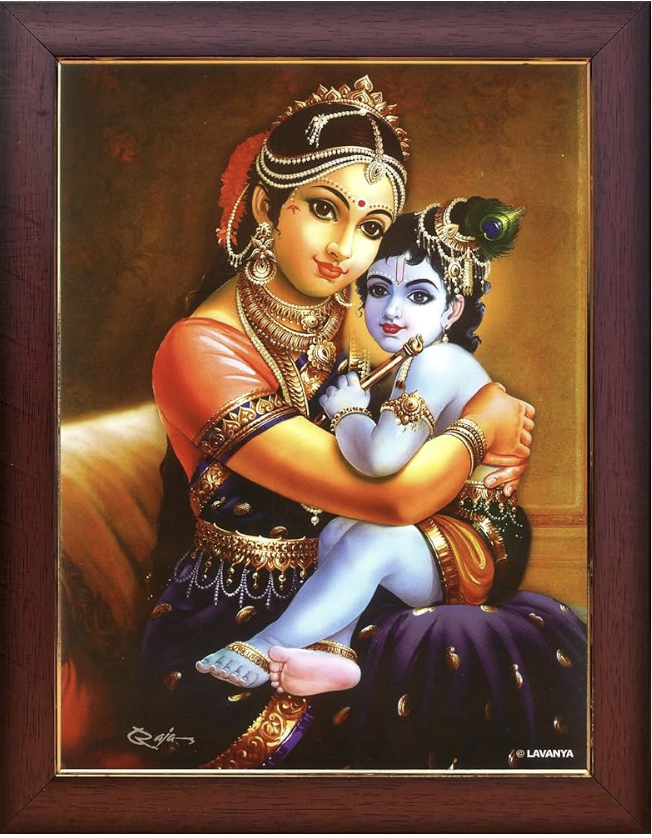
When you look into a child’s eyes, especially those of a very young one who has not yet acquired language, you can see the Infinite looking back. Pure wonderment, simplicity, and joy. Emotions move across a young child’s face like swift clouds across the sky, totally engrossing in one moment and gone in the next. There’s no trace of rigidity or conceptual mind, only direct experience in the present moment. This attitude is so appealing to us ego-bound grown-ups that we’re generally willing to forgive children for all sorts of behavior that would be reprehensible in adults. Consider the story of little Krishna caught stealing butter and denying it to his mother, Yashoda. This well-known and beloved ”lila”(divine entertainment) evokes fondness and such a sweet love that it’s as if Krishna had stolen not only butter but your own heart!
Krishna’s butter escapade ends with Yashoda trying to tie him up to keep him out of trouble, but no matter what she did, the rope was always two inches short, until finally Krishna relented and allowed her to bind him (As the Supreme Reality, though ungraspable, allows Himself to be “caught” by His pure devotees.)
Vatsalya-bhava encourages us to approach the Divine with softness and the kind of selfless devotion that a parent naturally shows to their child (At least, in a healthy familial situation.) It would be challenging for most of us to sacrifice so much of our time, energy, money, and sleep to care for another human being, but for a loving parent, this happens without a second thought.
As we move forward, we are all Mother Mary or Mother Yashoda, carrying the light of the world within us. Divine consciousness lies within the womb of existence. As a seed requires darkness under the earth to germinate, an infant requires nine months of sleep wrapped in its mother’s flesh. As a conscious human being, you are pregnant with the Christ-like child, with the potential for divinity to manifest itself through you.
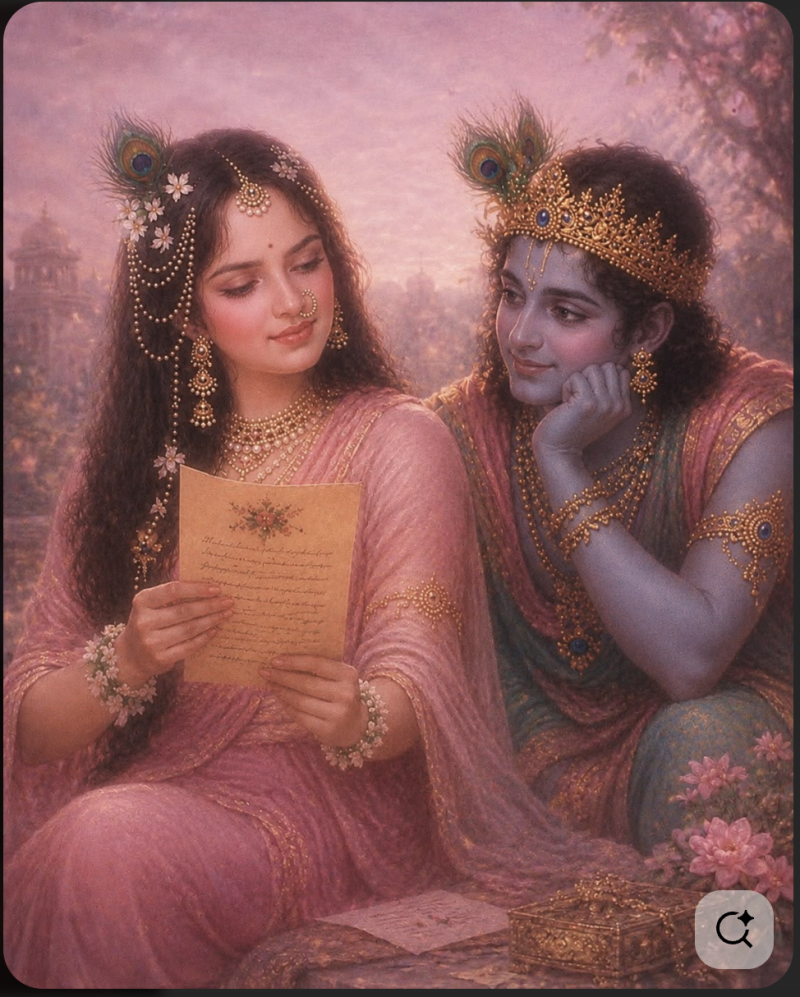
Madhurya-Bhava: The Mood of Lover and Beloved
King Solomon wrote; “Let him kiss me with the kisses of his mouth — for your love is more delightful than wine.” –The Song of Songs.
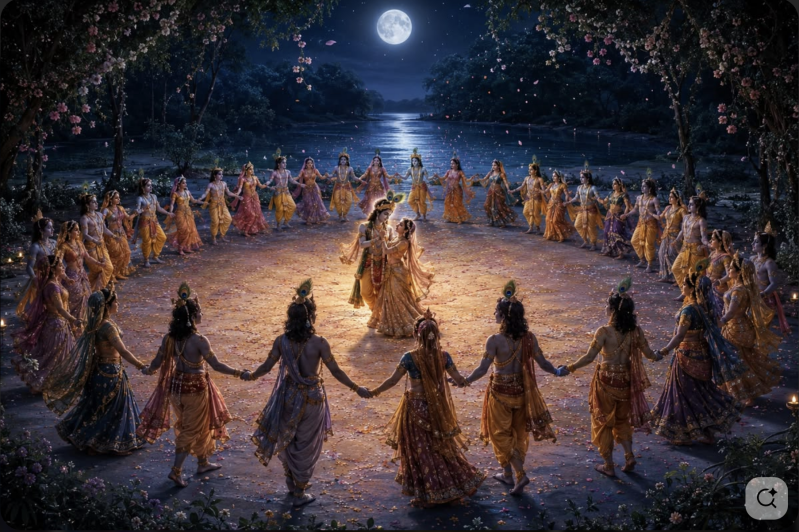
One warm night on the bank of the Yamuna, Krishna calls his gopis to Him by a sweet melody played on his flute. Time halts, so they dance together for an entire night of Brahma. Each girl feels alone with Him. He braids flowers, kisses lips and kohl-smeared eyes. Finally, He withdraws even from them and takes Radha alone to a secret place, where she disappears into Him and He into her.
Let me tear the veil with my hand that covers your full breasts, and so destroying all separation of you from me and of me from you forever! […]
“O Beloved, your eyes are too shy to look into mine. For once you flung yourself into anger against me. Open these flower-buds of your eyes, now! O Beloved, melt into Me and overflow above all barriers into Me!
–Gita Govinda (Jayadeva, translation Puran Singh and Paul Smith)
The mystery of divine union lies as a pulse within every dance of lover and beloved, although it transcends them. It is the underground river that nourishes all aspiration toward Truth. A whisper caught in one ear, the lightest touch which makes you tremble. It is the closest-kept secret of the devotee whose heart has become the Void of Voids, so wide open that only the Infinite can enter. Human relationships wax and wane, but divine love is a full moon that never fades. That bliss, the internal potency of God is ever fresh and ever increasing.
“When my mouth touched His, I became invisible, the way the earth would if the sun took it into its arms. The ecstatic death I know. What can touch His exquisite form is not anything that can be seen. How do we make love to God; How does the soul make love to God?” –St. Teresa of Avila
Krishna left Vrindavan at a young age and never returned to the groves and ponds of that sacred land, although Radha and the residents of Vrindavan wept inconsolably in His absence. And Krishna never left Vrindavan. He never leaves Radha, never leaves the hearts of His devotees. Even now, He is embracing His beloved — God is embracing the soul, Consciousness is embracing the world, Eternity is embracing the flickering dance of time — deep in the innermost cave of the Heart, as every breath carries the sweetness of jasmine blossoms and the softness of moonlight. God is the lover of the soul and the soul is the lover of God. Both are none other than the Self, in unlimited form.
Lovers are simultaneously one and two. They would not love each if they did not feel so keenly the abyss between them, but if they are true lovers, they cannot stop from leaning over the edge. Melting into love, you recognize that Presence which is Other to your ordinary self, Other to anything you could experience as an individual, whose very otherness allows you to inhabit a space of sacred relationship — yet which is entirely and unmistakably non-different from your true Self.
Naveen is a Hridaya teacher and a frequent contributor to Hridaya-yoga.com. You can read all of her posts there.


Shanta-Bhava: The Mood of Peaceful contemplation

Dasya-Bhava: The Mood of the Servant

Sakhya-Bhava: The Mood of Friendship


Vatsalya-Bhava: The Mood of Parental Love

Madhurya-Bhava: The Mood of Lover and Beloved